


HONG Myungseop, KIM Eull, HA Bongho, KIM Haemin
PARK Kiwon, KIM Taeheon, AHN Sihyeong, CHANG Jia
Works on View: 250 two-dimensional works, 6 photographs, 3 sculptures, 2 installations, 14 objects + text, and 1 media work - 276 works in total
Venue: gallery R
B01, Seongdong Semu Tower, 294 Gwangnaru-ro, Seongdong-gu, Seoul, Republic of Korea
TEL +82-2-6495-0001
E-mail galleryrkr@gmail.com
Exhibition Period: September 19, 2026 - March 19, 2027
Opening: Saturday, September 19, 2026, 1:00 PM
Artist Talk: Saturday, September 19, 2026, 3:00 PM
Opening Days: Tuesday - Saturday
Opening Hours: 1:00 - 7:00 PM
Closed: Sundays and Mondays
English Catalogue
Title: KAR (Korea Art Revelation)
Author: RYU Byounghak
Publisher: KAR Publishing
Publication Date: September 11, 2026
Pages: 1,512
Price: KRW 1,000,000
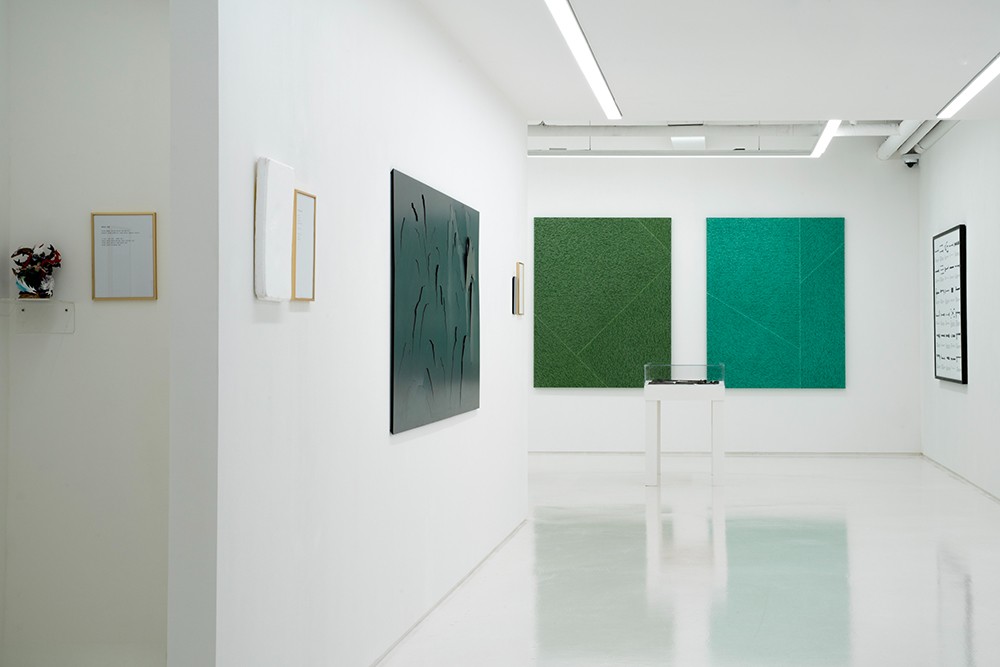
KAR_gallery R Exhibition View. 2026
Korea Art Revelation Co., Ltd. (KAR) was established in 2021 with the mission of discovering and bringing greater attention to undervalued Korean artists, identifying and supporting artists with the potential to engage with the international art world, and developing opportunities for Korean art in the international art market. To pursue these goals, KAR operates gallery R and KAR Publishing.
gallery R, directed by HWANG Youngbae, opened in Seongsu-dong, Seoul, in February 2022. With guest curator RYU Byounghak, gallery R organizes solo exhibitions featuring accomplished Korean artists. Over the past five years, gallery R has organized 45 exhibitions. KAR Publishing also publishes a series of ‘digital catalogues’ that enable readers to gain deeper insight into the work and practice of the artists exhibited at gallery R.
To date, KAR Publishing has published a total of 52 Korean-language digital catalogues and 11 English-language digital catalogues. The Korean editions are available through major online bookstores in Korea, including YES24, Aladin, Kyobo Book Centre, Millie’s Library, and RIDI Books, while the English editions are available through Amazon.
From September 19, 2026, to March 19, 2027, gallery R will present KAR (Korea Art Revelation), a special exhibition featuring eight artists: HONG Myungseop, KIM Eull, HA Bongho, KIM Haemin, PARK Kiwon, KIM Taeheon, AHN Sihyeong, and CHANG Jia. In conjunction with the exhibition, KAR Publishing will also publish KAR, an English-language catalogue of approximately 1,500 pages, priced at KRW 1,000,000. In other words, gallery R’s special exhibition KAR is conceived as an opportunity to introduce the works of eight Korean contemporary artists to international audiences.
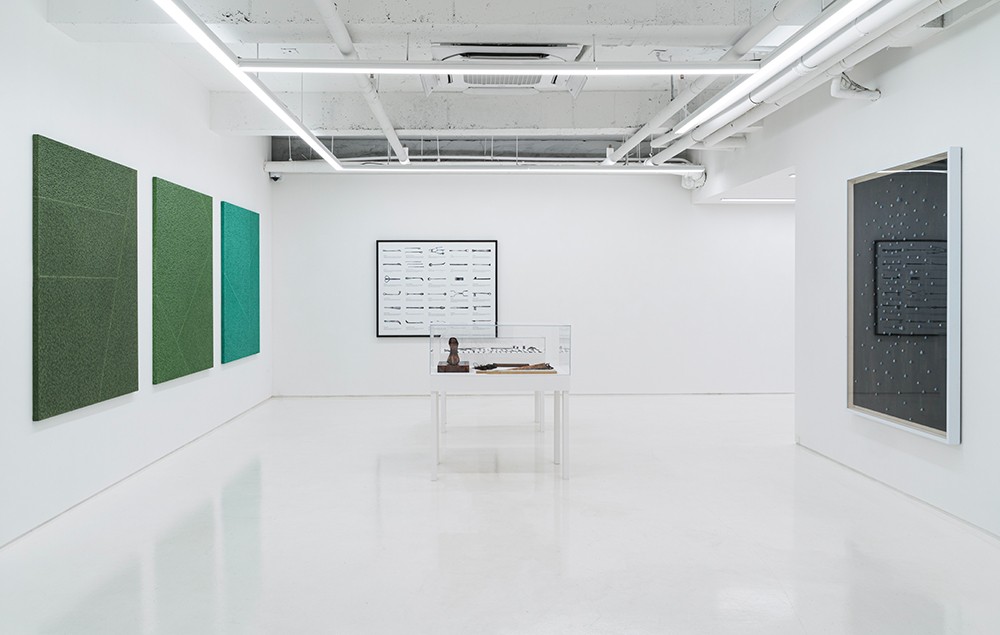
KAR_gallery R Exhibition View. 2026
KAR (Korea Art Revelation)
Unveiling the Veil of Korean Contemporary Art!
Eight Korean Contemporary Artists
gallery R’s special exhibition KAR presents the works of eight Korean contemporary artists whose practices have the potential to engage with the international art world. What does the exhibition title KAR mean, and who are these eight artists? Let us begin with the title itself.
In the introduction to gallery R, it is noted that KAR Co., Ltd. operates gallery R and KAR Publishing. According to HWANG Youngbae, CEO of KAR Co., Ltd., the corporate name ‘KAR’ is an acronym for Korea Art Revelation.
The word revelation is derived from the Latin revelare. The term revelare combines the prefix re- (‘again’ or ‘anew’) with velare (‘to cover’ or ‘to veil’), literally meaning “to remove the veil” or “to unveil.” Consequently, revelation carries meanings such as disclosure, unveiling, exposure, an unexpected truth, wonder, or even divine revelation. If so, might the name KAR, coined by HWANG Youngbae, ultimately signify unveiling the veil of Korean art?

KAR_gallery R Exhibition View. 2026
Now, let us turn to the eight Korean contemporary artists. They are HONG Myungseop, KIM Eull, HA Bongho, KIM Haemin, PARK Kiwon, KIM Taeheon, AHN Sihyeong, and CHANG Jia. Of course, all eight artists have already participated in international exhibitions. Nevertheless, I have described them as “artists with the potential to engage with the international art world.” This is because I believe that their works have yet to receive the recognition they truly deserve on the international art scene.
Through gallery R’s special exhibition KAR, I therefore hope to provide an opportunity for their works to receive the recognition they deserve. In other words, gallery R’s special exhibition KAR is conceived as an exhibition that introduces the works of these eight artists to international audiences. To this end, I am presenting the special exhibition KAR at gallery R and publishing the English-language catalogue KAR through KAR Publishing.
HONG Myungseop, Deconstructing Modern Sculpture
The eight Korean contemporary artists featured in gallery R’s special exhibition KAR are opening up new horizons in art by questioning established modernist art. Here, I would like to briefly discuss their artistic practices. Readers who wish to delve deeper into their work are invited to refer to my essays included in the English-language catalogue KAR, published by KAR Publishing.

HONG Myungseop_de·veloping the waterfall_cotton. 1978
HONG Myungseop graduated from the Department of Sculpture at the College of Fine Arts in 1976 and received his master’s degree in sculpture from the Graduate School of Seoul National University in 1986. In 1978, he created a kind of ‘installation’ that departed from conventional sculpture. His de·veloping the waterfall (1978) consisted of a long piece of white cotton cloth laid over rocks from the top of a valley down toward the bottom, as though a waterfall were cascading through the landscape.

HONG Myungseop_de·veloping; silhouette casting_iron plate_cutting and lifting_60×100×60cm. 1983
Beginning in 1980, HONG Myungseop began creating a kind of ‘topological sculpture.’ Examples include pipe operation (1980), in which pipes are transformed into various configurations, and de·veloping; silhouette casting (1983), a sculpture made by cutting the silhouette of a fork out of an iron plate and lifting the cut-out form upright. His ‘silhouette casting’ reverses the proposition that “every object casts a shadow,” revealing instead that “every shadow gives rise to an object.”

HONG Myungseop_running railroad_taping on the wall_1400×900×340cm. 1982
In his 1982 solo exhibition at the Daejeon Cultural Center Gallery, HONG Myungseop presented the installation running railroad. It was a kind of ‘spatial work,’ created with black masking tape across the expansive walls and floor of the exhibition space. As a result, the viewer is situated within the work itself.
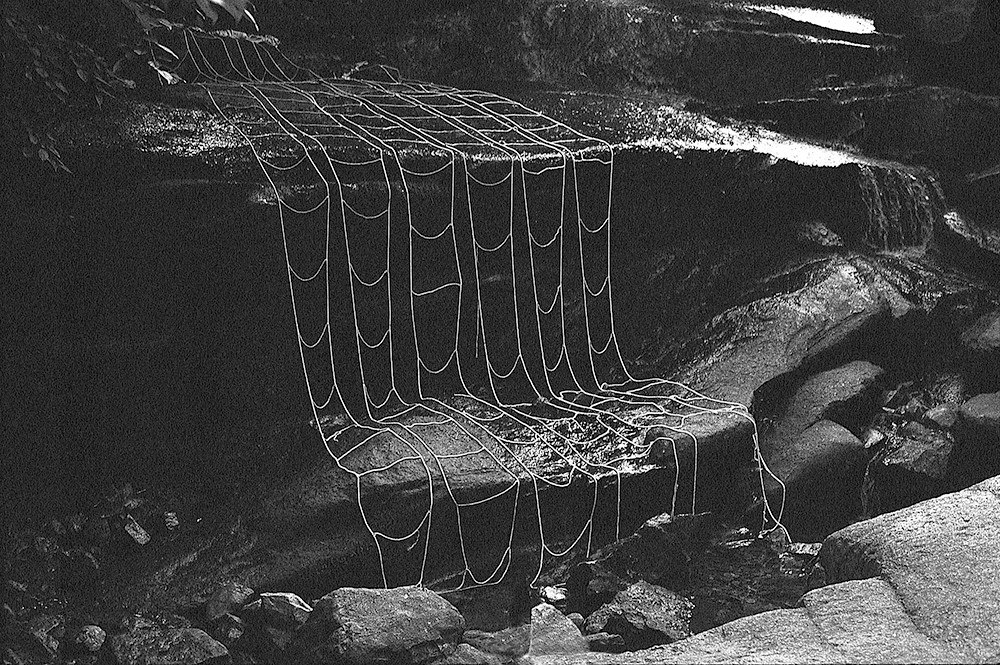
HONG Myungseop_de·veloping the waterfall_cotton cord. 1986
In 1986, HONG Myungseop returned to the valley. This time, instead of cloth, he laid cotton cord over the rocks from the top of the valley down toward the bottom, as though a waterfall were cascading through the landscape. Interestingly, in what might be called his ‘cotton-cord waterfall,’ he arranged the cord in a grid resembling Korean manuscript paper (won-go-ji).
That same year, he participated in the group exhibition Hard-core at the Daejeon Cultural Center Gallery, where he installed his ‘manuscript-paper cord’ across the gallery floor and over BOK Jongsoon’s ‘paper rocks.’
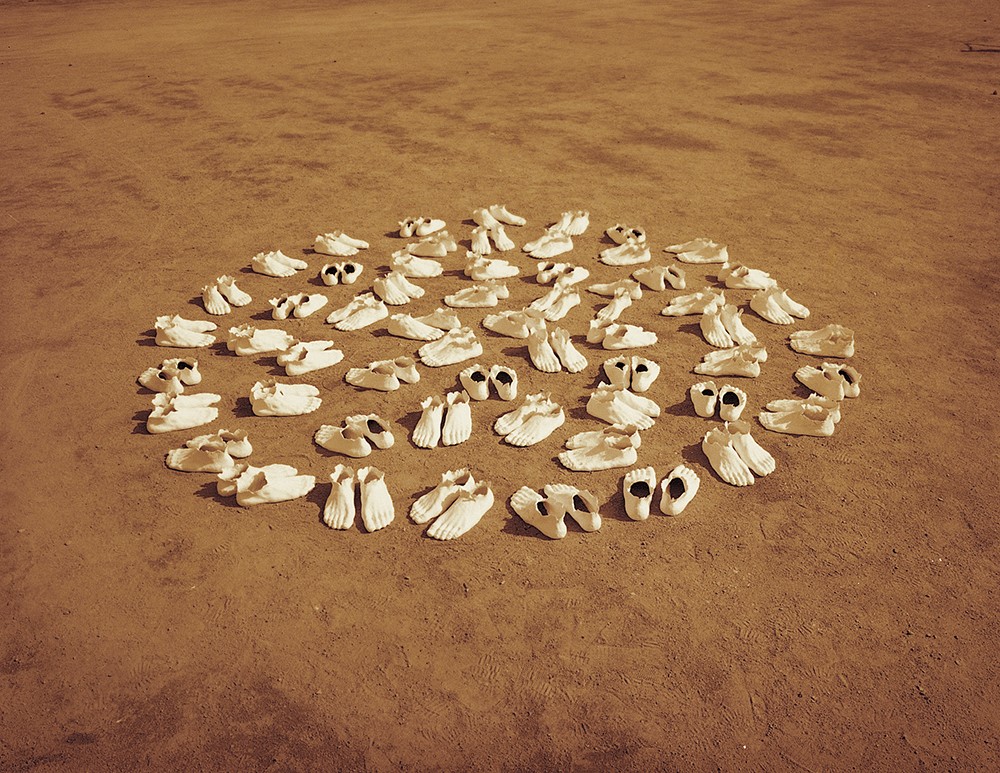
HONG Myungseop_homage to Richard Long_paper clay_600×600cm. 1993
In 1993, HONG Myungseop created de·titled, a work consisting of foot-shaped sculptures larger than actual human feet, molded in hwaseonji (traditional Korean calligraphy paper)? what might be called his ‘hwaseonji feet.’ Just as his ‘metal feet’ were hollow, shell-like forms, these ‘hwaseonji feet’ were also completely empty inside.
At ASIANA, a special exhibition held in conjunction with the 1995 Venice Biennale, German critic Claudia Delank saw HONG Myungseop’s ‘hwaseonji feet’ and asked him, “Why do you deliberately choose paper, such a fragile and easily breakable material?” Let us hear HONG’s response in his own words:
“I find the ‘permanence’ associated with traditional, rigid sculptural materials repulsive. In this particular work with paper feet, the emotional quality arising from the material itself - its fragility and delicacy, like the cast-off shell of an insect - became one of the primary motifs of the work. Is it not precisely in something as fragile as a dragonfly’s wing that we can glimpse signs of life?”
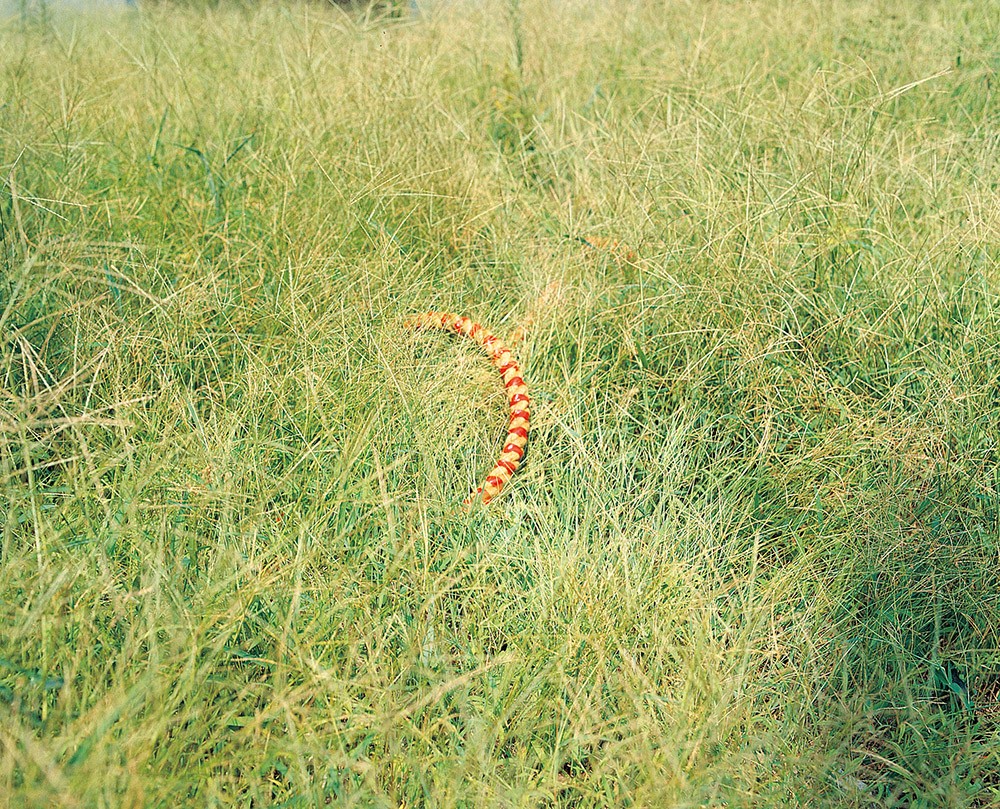
HONG Myungseop_as if..._tape, rod_dimensions variable. 1994
In 1994, HONG Myungseop created like a snake by wrapping red tape around a cord and installed it among dense weeds in a wooded area so that it appeared ‘like a snake.’ HONG explains that he conceived the notion of “as if...” through the idea of camouflage as “a kind of alternative concept devised to deconstruct and move beyond ‘representation’ and ‘expression.’” He further states that it signifies “a fictional device that is not real in itself, yet functions as if it were real.”
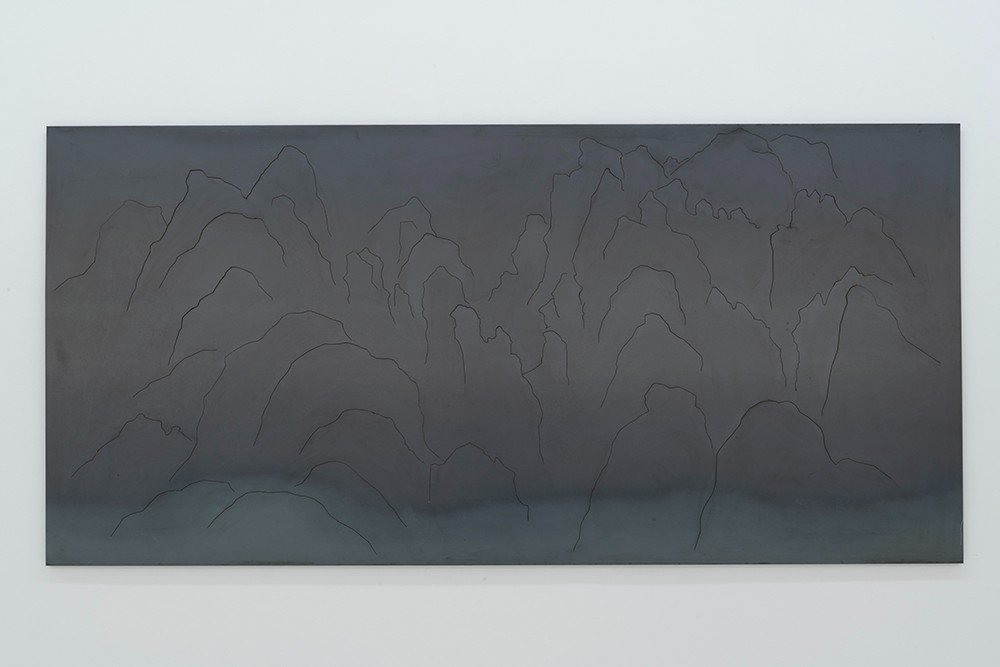
HONG Myungseop_as if a painting of the Geumgang Mountains_iron plate 1,6t, laser-cut and pushed steel plate_95×200cm. 2026

HONG Myungseop_as if in Dream Journey to the Peach Blossom Land_iron plate, 2t, laser-cut and pushed_90×240 cm. 2025
HONG Myungseop presents as if in Dream Journey to the Peach Blossom Land (2025) and as if in a Painting of the Geumgang Mountains (2026) in gallery R’s special exhibition KAR. As its title suggests, as if in Dream Journey to the Peach Blossom Land was created after AN Gyeon’s Dream Journey to the Peach Blossom Land (Mongyu Dowondo). AN Gyeon’s Mongyu Dowondo is a landscape painting commissioned by Prince Anpyeong (安平大君) after he dreamed of visiting the Peach Blossom Land (桃源) and described his dream to the artist.
While AN Gyeon’s Mongyu Dowondo is a 38.7×106.5 cm landscape painted in ink and light color on silk, HONG Myungseop’s as if in Dream Journey to the Peach Blossom Land is made from a 90×240 cm iron plate, 2 mm thick, cut with a laser. Following the silhouettes of the gently rounded earthen mountains and strangely shaped rocky peaks depicted by AN Gyeon, HONG laser-cut their outlines into the plate. He then pulled the cut sections slightly forward to varying degrees, creating a fantastical vision of the Peach Blossom Land.
HONG Myungseop’s as if in Dream Journey to the Peach Blossom Land can therefore be described as a kind of “shadowless sculpture” that is neither two-dimensional nor three-dimensional in the conventional sense. His de·veloping the waterfall, like a snake, pipe operation, and de·veloping; silhouette casting can likewise be regarded as “shadowless sculptures.” In this sense, HONG’s “shadowless sculpture” deconstructs the conventions of traditional sculpture.
Traditional sculpture generally refers to a three-dimensional form realized in concrete material within three-dimensional space - a strong and solid construction possessing volume. A ‘solid’ is a bounded region of three-dimensional space enclosed by multiple planes or curved surfaces. Volume, in turn, refers to the amount of space occupied by a three-dimensional object possessing width, height, and depth. Sculpture, therefore, traditionally means the creation of a three-dimensional solid form by working concrete materials with tools. Ultimately, three-dimensional sculpture casts a shadow.
HONG Myungseop’s as if in Dream Journey to the Peach Blossom Land is made by cutting a 2 mm-thick iron plate “as if it were a landscape painting” and installing it on the gallery wall. In this sense, the work can be regarded as a kind of ‘topological sculpture’ that calls conventional notions of sculpture into question.
Moreover, because as if in Dream Journey to the Peach Blossom Land appropriates AN Gyeon’s Mongyu Dowondo (Dream Journey to the Peach Blossom Land) and translates it into a laser-cut iron plate, the work is deliberately impersonal and devoid of virtuoso craftsmanship. In this respect, it might be described as a kind of “artless art.” On this point, HONG wrote the following in an artist’s note in 1986:
“From an early age, I never believed in anything like my own individuality, nor did I ever wish to possess any particular individuality. Even now, I feel that I want to dismantle my own self, and that I should remain in the process of dismantling it. This is because, for me, art begins where metaphysical problems begin to be dismantled.”
Furthermore, HONG Myungseop’s as if in Dream Journey to the Peach Blossom Land might be described as a kind of “mindless” sculpture that, to borrow his own words, “experiments with the potential of non-humanist sensibilities, what lies beyond concepts, non-conceptual ideas/impulses, and heterogeneous forms of thought that inevitably resist social issues and conventional notions.”
Of course, the three concepts that run throughout HONG Myungseop’s artistic practice - shadowless, artless, and mindless - intersect with and move across one another. Interestingly, these three concepts deconstruct the fixed conventions of traditional art. They might therefore be understood as a kind of ‘meta-concept.’ Does HONG, then, emerge as an adversary of metaphysical art, deconstructing modern art itself?
KIM Eull’s ‘Beyond Art History’
In 1982, KIM Eull graduated from the Department of Metal Craft at Wonkwang University and worked as a designer at Esquire for approximately two years. He later enrolled in the Graduate School of Industrial Arts at Hongik University and, after graduating in 1989, decided to devote himself entirely to painting, feeling that he “could no longer put off painting.”
In pursuit of the birth of a new art, KIM deconstructs established concepts of art, including drawing, painting, and sculpture. In 2016, he attracted considerable attention at the Korea Artist Prize exhibition at the National Museum of Modern and Contemporary Art (MMCA), Seoul, where he presented Galaxy, comprising 1,350 drawings, and Twilight Zone Studio, a two-story architectural structure.
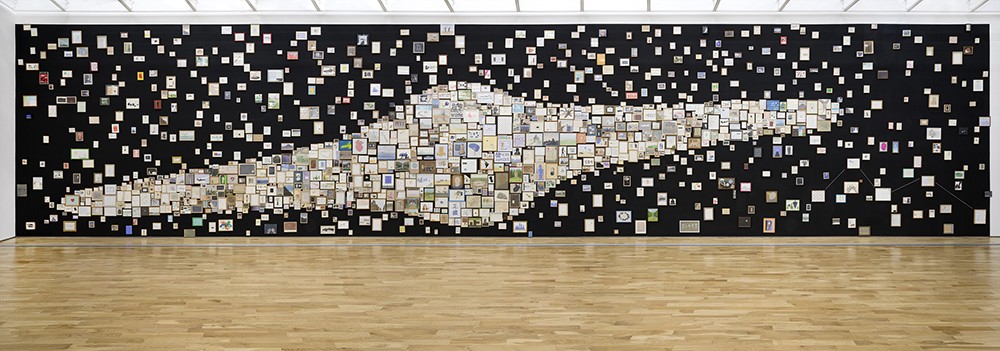
KIM Eull_Galaxy_1,350 drawings_630×2,700cm. 2016
Now in the collection of the National Museum of Modern and Contemporary Art (MMCA), KIM Eull’s Galaxy consists of 1,350 drawings installed across a black wall nearly thirty meters long, like stars glittering in the night sky - a Milky Way of drawings. If you were to look closely at his more than one thousand drawings, you would discover that they encompass not only conventional drawing but also painting, printmaking, photography, and even sculpture. His drawings thus challenge, disrupt, contaminate, and ultimately subvert the traditional divisions of art.
KIM describes drawing as “not a form, but an attitude of expressing oneself freely,” and says that drawing is “something done not with a brush or pencil, but with a hammer.” If we were to borrow Nietzsche’s voice, then, might we not describe KIM Eull’s drawing as making art with a hammer?
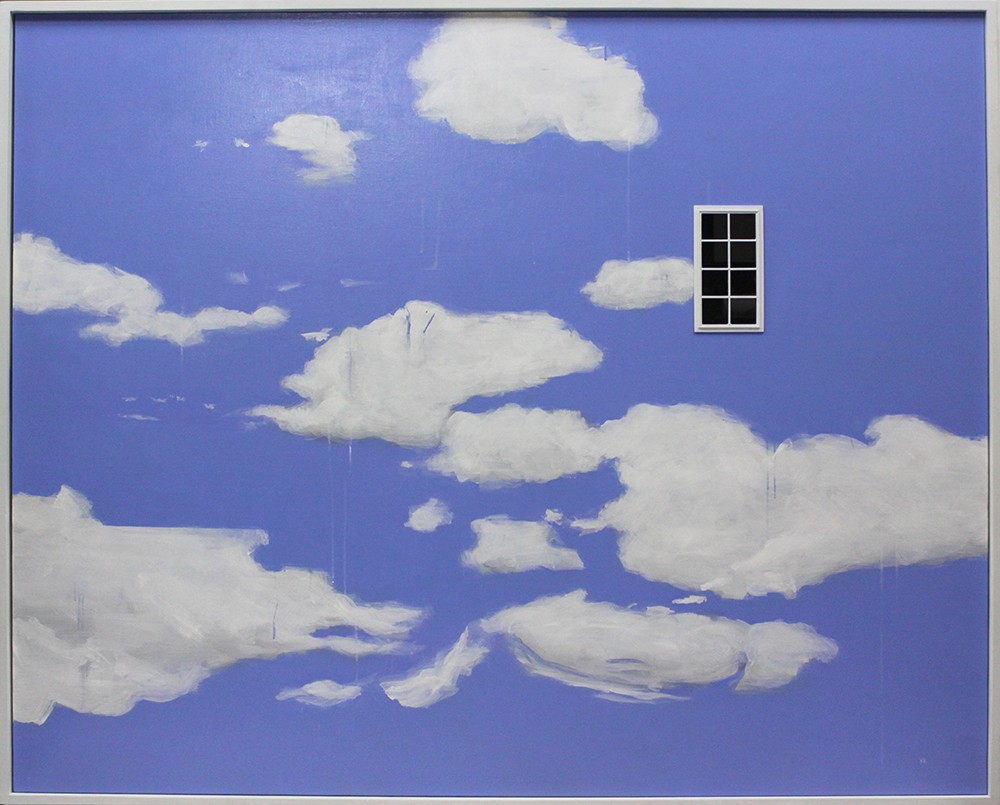
KIM Eull_Beyond the Painting_mixed media_136×168×14cm. 2017
Painting generally refers to an image rendered with ink or paint on a two-dimensional surface, such as hanji or canvas. KIM Eull’s Beyond the Painting, however, employs a canvas approximately 10cm thick and incorporates various objects. It is therefore both painting and sculpture, while at the same time being neither painting nor sculpture. Does it not, then, deconstruct the traditional artistic dichotomy between two-dimensional painting and three-dimensional sculpture? Let us hear KIM explain it in his own words:
“My Beyond the Painting series is structured so that, as a physical construction, a dark space exists behind the painted surface, while these two spaces - the front and the back - are connected through a passage in the form of a ‘window.’ Passing beyond the meaningless space of the surface and into the dark, silent, imaginary space that lies behind it, the viewer is invited to infer and imagine a world of truth omitted from the surface, thereby exploring a contemplative and freely imagined aesthetic realm. In this process, the viewer moves beyond a passive role and encounters the painting from an active position.”
KIM Eull’s Beyond the Painting series consists not only of images painted on canvases approximately 10cm thick but also of arrangements incorporating a variety of objects, making it ambiguous whether these works should be regarded as paintings or sculptures. In other words, Beyond the Painting series is composed of a mixture of the real and the virtual. Is KIM not, then, seeking to deconstruct the established framework of art and create new values? Indeed, he is. He deterritorializes the existing territory of ‘art’ and creates a new territory of his own.

KIM Eull_TZ Studio_mixed media_590×850×360cm. MMCA. 2016
Now, let us turn to KIM Eull’s Twilight Zone Studio, a two-story architectural structure presented at the Korea Artist Prize exhibition in 2016. The word ‘twilight’ literally refers to the faint illumination of the sky around sunrise and sunset and may be understood as the dim light of dawn or dusk. When used figuratively, however, ‘twilight’ can suggest something mysterious, obscure, or existing in an in-between state. The expression ‘twilight zone’ thus evokes an unknown or indeterminate realm.
Viewers are able to enter KIM’s Twilight Zone Studio. The interiors of both the first and second floors are filled not only with his ‘drawings’ and works from the Beyond the Painting series, but also with a wide variety of objects he has collected for his artistic practice. The studio is even equipped with worktables, tools, and materials, as though he could begin working there at any moment.
Within the ‘real space’ of the studio, KIM creates ‘virtual works.’ His studio can therefore be understood as a hybrid space in which reality and the virtual coexist. In other words, in Twilight Zone Studio, KIM has arranged a variety of works in such a way that reality seeps into fiction, while fiction takes root within reality.
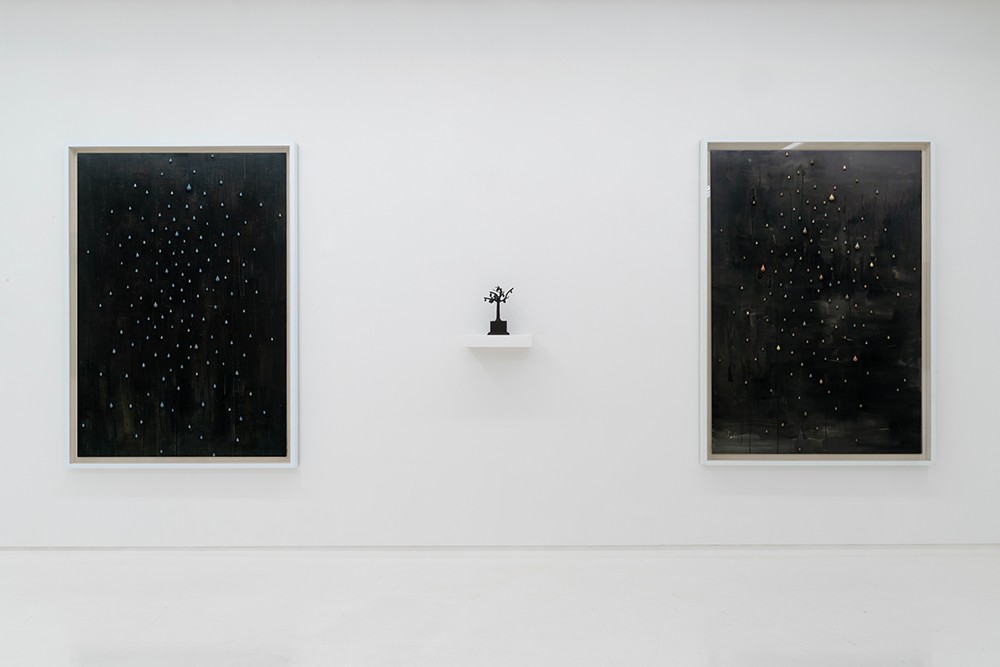
Left) KIM Eull_Tears I_mixed media_174×123×6.5cm. 2025
Center) KIM Eull_Tears Tree_mixed media_15×16×26cm. 2026
Right) KIM Eull_Tears II_mixed media_174×123×6.5cm. 2026
For gallery R’s special exhibition KAR, KIM Eull presents two paintings from his series and one object work, Tears Tree. His Tears paintings feature dozens of tear-shaped objects attached to dark backgrounds. What? You want to know how his ‘tear objects’ are made? One of KIM’s Tears drawings provides the following instructions:
1) Grind bones into a fine powder.
2) Add an appropriate amount of water and animal glue to the bone powder, mix them together, and knead thoroughly until the mixture reaches a clay-like consistency.
3) Allow the mixture to dry slightly until it is suitable for shaping, then form it into teardrop shapes.
4) Leave the teardrops to dry thoroughly in the shade to complete the process.
KIM Eull’s Tears series can be traced back to 2007. His Tears (2007) depicts tears painted in light blue on canvas. In Tears (2008), he painted the canvas light blue and attached white tear-shaped objects to its surface. For History of Tears (2010), he wrote the title “History of Tears” on the cover of a book and attached tear-shaped objects to it.
KIM also created works in which these tear objects are loaded into a doe - a traditional Korean measuring vessel used for measuring quantities of grain and other materials - as well as into toy carts and toy trucks. Eventually, he even created Tears Shop (2010).
I would like to describe KIM Eull’s work, which demonstrates a complex understanding of multiple artistic genres, as a kind of ‘mixed material arts.’ This is because his ‘mixed material arts’ calls for a new paradigm of art. In “Beyond Art History,” KIM states that “while we should respect art history, it also seems necessary, on the other hand, to disregard it,” before making the following thought-provoking observation:
“Without being bound by historical understandings of art or preconceived notions about it, we need to understand and analyze our own time in original ways, and to undertake our own inquiries and efforts toward realizing the aesthetic values of the contemporary era. The history of art as we know it could hardly have been the best possible course it might have taken. If there had been a more desirable course, what might contemporary art look like today? I am deeply curious.”
HA Bongho: Moving Beyond Photography Through Photography
HA Bongho graduated from the Department of Photography at Osaka University of Arts in Japan in 1986 and subsequently completed a two-year postgraduate research program in photography at Nihon University. From 1986 to 1992, he worked at Photomas Studio and POTHOM Co., Ltd. in Japan. After returning to Korea, he founded hawamodu, a group dedicated to creating light and photography and specializing in automotive photography, in 1994. He currently serves as the head of hawamodu while continuing his practice as an artist.
During his studies in Japan, HA worked on the DOSIIN series and the BURNING series. After returning to Korea, he went on to produce the Self-Portrait series, the Red Signal series, and the Plastic Beauty series. While the DOSIIN and BURNING series consist of analog photography, the Self-Portrait series consists of digital photography.

HA Bongho_GUNGJI #002_Digital C-Print_150×280cm. 2006
I could not help but be astonished the moment I encountered HA Bongho’s monumental black-and-white Self-Portrait series, measuring nearly three meters in scale. This was because his ‘self-portraits’ appeared to me almost like monsters. In other words, although the figures in his Self-Portrait series assume human forms, their body parts are combined in bizarre and unexpected ways. HA Bongho describes his Self-Portrait series as follows:
“My Self-Portrait series is the result of modeling myself using MAYA, a 3D software program, then cutting away certain parts of my body, distorting or twisting others, mapping onto the body an image of myself screaming at the top of my lungs, and finally rendering it. In GUNGJI, only my body and my face appear, but perhaps, somewhere within it, he and I are entangled with one another.”
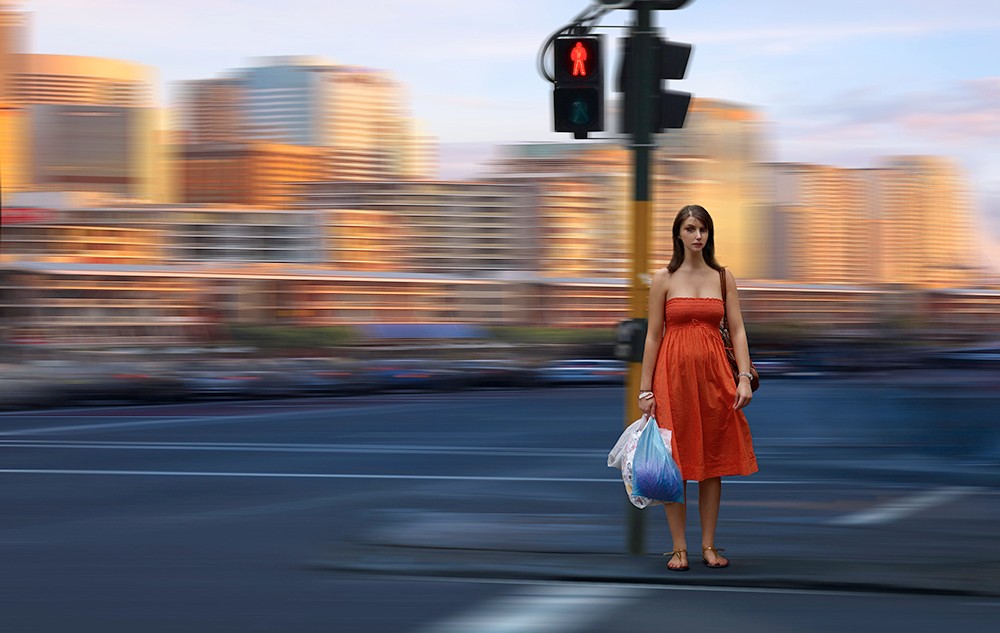
HA Bongho_RED SIGNAL SYD #008_Digital C-Print_250×150cm. 2007
HA Bongho’s Red Signal series and Plastic Beauty series are likewise works of digital photography. As the title Plastic Beauty suggests, the women appearing in these photographs are figures digitally ‘reconstructed’ on a computer. Just as a plastic surgeon makes people beautiful, HA decided to make people beautiful through the image-retouching techniques he had honed in the fiercely competitive world of commercial photography.
As a strategy for resisting the inescapable program of photography, HA composites and manipulates photographic images using Photoshop. Rather than taking photographs that anyone could take, he responds to the automation of the camera by creating photographic works that no one could possibly photograph. If I may borrow the voice of Gilles Deleuze, I would say that HA Bongho’s photographic works seek to move beyond photography through photography.
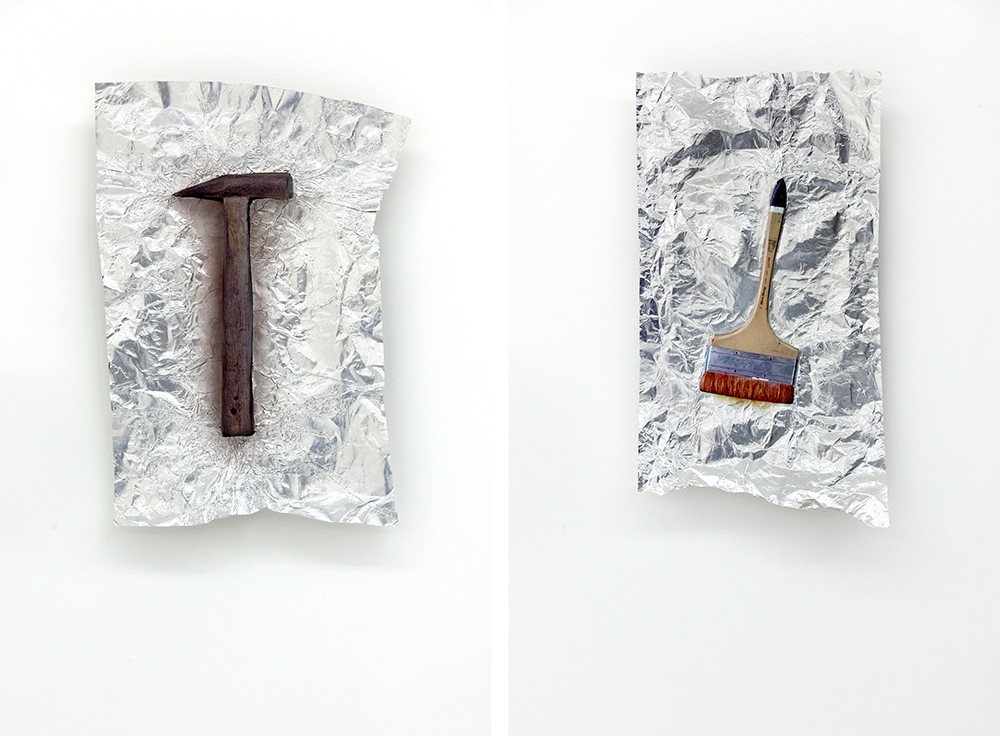
Left) HA Bongho_Hammer_Print on Cooking Foil_34×47×3(d)cm. 2022
Right) HA Bongho_Brush_Print on Cooking Foil_35×63×0.5(d)cm. 2022
HA Bongho held three solo exhibitions at Gallery R in 2022. At the time, he presented his Object series, in which photographs were printed on cooking foil rather than conventional photographic paper, as well as his Cotton-Photograph series, in which photographs were printed on cotton. His Object series consists of photographic works in which images of objects - a hammer, a stone, and a brush - are printed on cooking foil.
What? How could he possibly print objects onto cooking foil? First, HA takes a flat sheet of cooking foil and casts an actual hammer with it. He then unfolds and flattens the resulting ‘relief-hammer’ made of cooking foil. Traces of the hammer remain impressed upon the flattened foil. Onto these traces, he prints a photograph of the actual hammer. Finally, he places the cooking foil bearing the printed image of the hammer back onto the actual hammer and casts it once again.
What? Even if he prints a photograph of the actual hammer onto the traces left on the flattened cooking foil and then places the foil back onto the actual hammer to cast it again, it still would not conform precisely to the shape of the real hammer? Exactly! The artist photographs the actual hammer, downloads the image onto his computer, and uses Photoshop to create an unfolded image showing the hammer’s front and sides laid out on a flat plane. In other words, he transforms the image of the three-dimensional hammer into a two-dimensional unfolded pattern. He then prints this unfolded photograph onto the cooking foil bearing the traces left by the original casting of the hammer. Finally, he places the cooking foil bearing the printed image back onto the actual hammer and casts it once again.
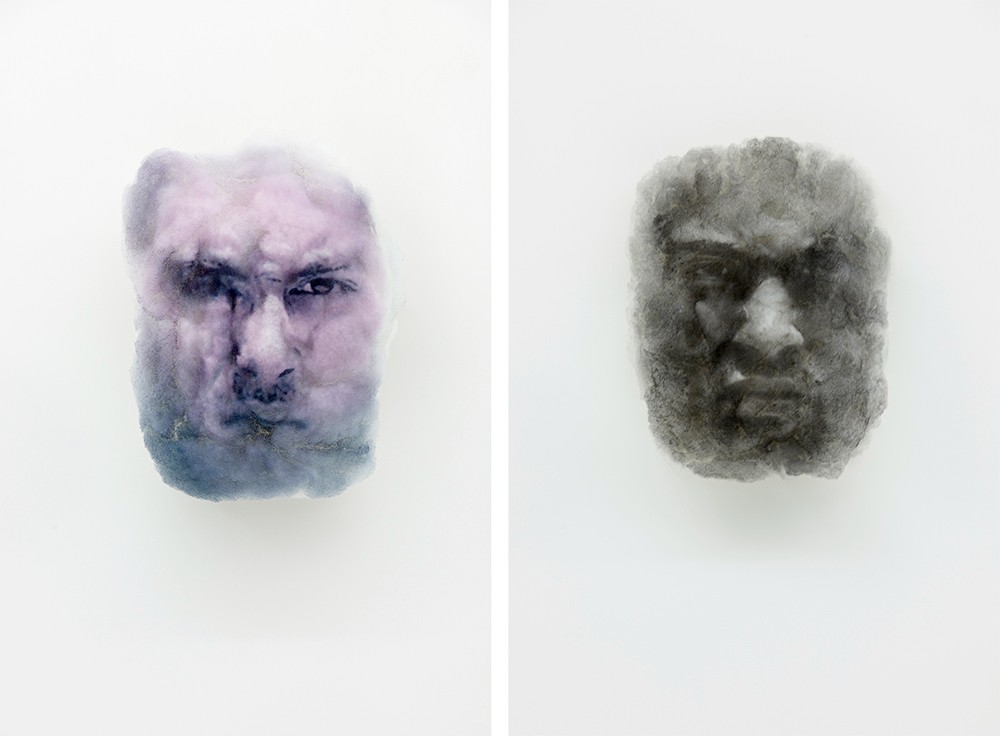
Left) HA Bongho_Richard I_Print on Cotton_36×48×21(d)cm. 2022
Right) HA Bongho_Richard II_Print on Cotton_37×50×15(d)cm. 2022
Now, let us turn to HA Bongho’s Cotton-Photograph series. His Richard series consists of two works, Richard I and Richard II. In both works, the face of a man is printed onto a soft mass of cotton. Richard I is printed in color, while Richard II is printed in black and white. At first glance, Richard I and Richard II appear to depict the faces of two different men printed on separate masses of cotton, yet both works bear the same name, “Richard.” Regarding this apparent discrepancy, HA Bongho states:
“My Richard I and Richard II were both printed from a single original photograph onto separate masses of cotton. In other words, the original photograph for the Richard series is a photograph of one man’s face. I printed the same photograph onto two different masses of cotton, but the resulting images appeared as two different faces.”
The masses of cotton HA Bongho used for Richard I and Richard II are not identical. No matter how hard he might try to make two identical masses of cotton, it would be impossible to make them exactly the same. Therefore, even when he prints the same original photograph onto two separate masses of cotton, two entirely different figures emerge. Now you see why he titled the two works Richard I and Richard II, don’t you?
HA Bongho’s Cotton-Photographs dismantle the conventional concept of photography. This is because, like paintings, his Cotton-Photographs are unique works - photographs that cannot be reproduced. Accordingly, his Cotton-Photographs have no editions. In this respect, I regard his Cotton-Photographs as works that seek to move beyond photography through photography. In a word, his Cotton-Photographs signify a revolution in photography.
Throughout the history of photography, photographs have traditionally been printed on flat photographic paper. HA Bongho’s Cotton-Photographs, however, replace the conventional two-dimensional photographic paper with irregular masses of cotton as the surface on which images are printed. His Cotton-Photographs thus challenge the entrenched notion that photographs must be printed only on flat, two-dimensional surfaces.
Paradoxically, HA Bongho’s Cotton-Photographs might even be described as an origin of photography. This is because they expand photography beyond photographs conventionally printed on flat photographic paper, opening up the possibility that photographic images can be printed on virtually any object. In this sense, his Cotton-Photographs have expanded the “entrance” to photography. If I may borrow the voice of Nam June Paik to speak of HA Bongho’s Cotton-Photographs, I would put it this way:
HA Bongho has created a vast entrance and a very narrow exit for photography through his Cotton-Photographs. If you wish to move beyond HA Bongho’s Cotton-Photographs, you will have to make your way out through the narrow “exit” he has created.
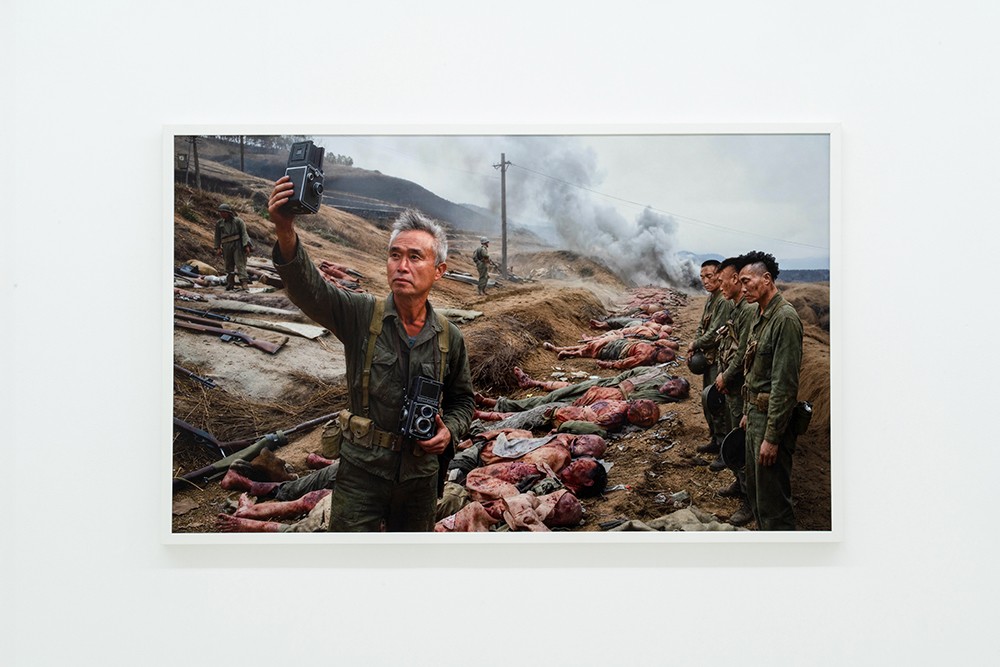
HA Bongho_Self-Portrait_Digital Print_119×72cm. 2025
For Gallery R’s special exhibition KAR, HA Bongho presents Self-Portrait (2025), Porsche Byeolgok (2006), and the All Images Overlap series (2026). All of these works were created using AI.
His Self-Portrait evokes the Korean War of the 1950s. A war photographer holds a vintage twin-lens reflex camera in one hand as he takes a self-portrait, while behind him lie dozens of fallen soldiers in a trench, with other soldiers standing nearby in mourning.
His Self-Portrait is an AI-generated photograph. In other words, the war photographer, the fallen soldiers, and the standing soldiers depicted in the photograph are all AI-generated figures. Although they appear at different ages and with different features, they are, much like the figures in his Richard I and Richard II, all the same person. HA provided AI with his own identification photograph and asked it to generate multiple versions of himself at different ages and with different appearances. In his artist’s note on Self-Portrait, HA writes:
“I wanted to express my life through a scene from a battlefield that evokes an extremely realistic documentary photograph of the Korean War in the 1950s. Everyone’s life ultimately ends in death, and there are neither heroes nor victors there. All that remains is the gesture of trying to record (remember).”
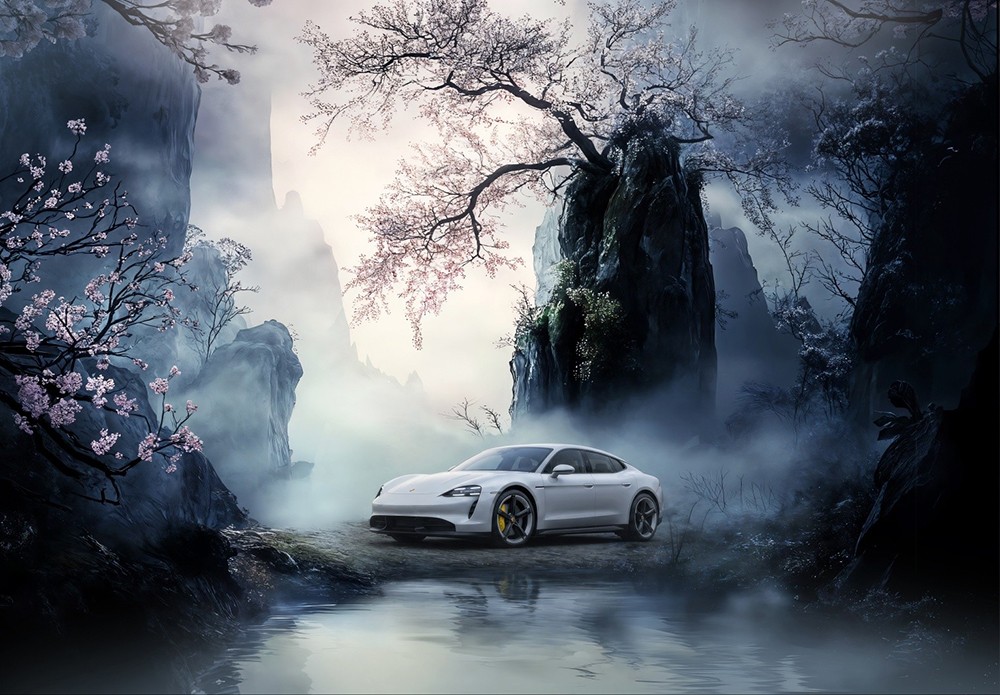
HA Bongho_Porsche Byeolgok_UV Print on Hanji_1020×740mm. 2026
HA Bongho’s Porsche Byeolgok is a UV print on hanji. It depicts a Porsche set against a landscape reminiscent of a traditional ink painting. The ink-painting-like landscape, of course, is an image generated at HA’s request using AI. As mentioned earlier, HA works professionally in new-car photography. These days, however, rather than photographing new cars in a vast studio, he sits in his office, turns on his computer, and creates images of new cars using AI. In this sense, his Porsche Byeolgok is a photograph generated by AI without either lighting equipment or a camera.

Left) HA Bongho_All Images Overlap Gray_UV Print on Premium Matte_1140×880mm. 2026
Right) HA Bongho_All Images Overlap Black_Archival Pigment Print on Premium Matte_1140×880mm. 2026
HA Bongho’s All Images Overlap series consists of photographs generated by AI by superimposing, as the title suggests, all the images in the world. HA asks ChatGPT what comes to mind when it thinks of “all the images in the world.” ChatGPT responds as follows:
“The first thing that comes to mind is an impossible archive. A person’s face, a family photograph, a satellite image, a medical image, a child’s scribble, a cave painting, CCTV footage, an advertisement, a painting, even an AI-generated image - all these seemingly unrelated things are brought together into a single collection. It is no longer ‘photography’ or ‘art,’ but rather every trace of humanity’s attempt to understand the world through vision. The next thing that comes to mind is memory. Humans have preserved their memories not only through language but also through images. To gather all the images in the world therefore feels like gathering the memory of humanity in one place. Within it are beauty and war, love and ordinary days. Yet there is also a paradox. If we were to see all the images in the world in a single image, it seems that we would see nothing at all. Too much information can instead result in the loss of information. Just as all sounds heard simultaneously might sound like silence, when all images exist simultaneously, any single scene disappears. For this reason, I understand ‘all the images in the world’ not so much as an expression of completeness, but as something that evokes a limit. Humans can imagine it, but they cannot actually see it. If I were to put it in a single phrase, ‘all the images in the world’ is not a single picture, but the boundary between what humans can see and what they cannot see. That is the first thought that comes to mind.”
KIM Haemin, Media-Shaman
KIM Haemin is a first-generation Korean media artist who carries on the legacy of Nam June Paik, widely known as the “father of video art.” He first attracted widespread attention in the art world in 1992 with TV Hammer, a work that caused a considerable stir. Since then, he has produced works addressing a wide range of subjects, including not only art itself but also human life and death, the division of North and South Korea, and religion. If one were to identify a defining characteristic that runs throughout his body of work, it would above all be his remarkable ability to analyze the nature and mechanisms of media.
In the early 1980s, after completing his military service, KIM Haemin met an acquaintance who was running a video studio at the time. One day, KIM visited the studio and encountered a personal camcorder for the first time. The camcorder he saw would most likely have used either Betamax, the VTR format developed by Sony in Japan in 1975, or VHS (Video Home System), the home videocassette recording format developed by JVC in Japan in 1976. He became fascinated by the medium of ‘video,’ which, unlike photography, could capture moving images. This fascination led him to take a keen interest in the mechanisms of video.

KIM Haemin_TV Hammer_Monitor 1, DVD Player 1, Image Control Device 1_Media Installation. 10min. 40sec. 1992
In 1992, KIM Haemin first presented TV Hammer, which would become one of his signature works, in the special exhibition Positions at Hyundai Gallery in Daejeon. The work consists of a TV monitor installed on a white pedestal as though it were a sculptural object. On the monitor, clouds drift across a clear blue sky. Yet as a viewer approaches the TV monitor, a hammer suddenly appears against the blue sky. With a sudden “BANG!,” the hammer strikes the TV screen, and the monitor goes dark.
Startled, the viewer watches as the monitor soon turns back on, revealing what appears to be a dent left by the hammer on the screen. The hammer then reappears on the screen and moves back and forth toward the viewer before once again striking the TV screen with a resounding “BANG!” At that very moment, the TV monitor itself jolts. The viewer is startled once again. KIM Haemin’s TV Hammer can therefore be described as a work that ingeniously fuses the real and the virtual.

KIM Haemin_R.G.B Cocktail_Glass 2, Video Projector 2, DVD Player_Media Installation. 2001
KIM Haemin’s R.G.B Cocktail (2001) consists of two enormous cocktail glasses installed on pedestals as though they were sculptural objects. Each glass appears to contain a blue (B) or red (R) alcoholic drink. But wait - aren’t bubbles rising from the bottom of the liquid(?) inside the cocktail glasses? After a while, the colors of the cocktails begin to change, shifting, for example, from blue to red and then to green.
What? What is going on here? A woman in a bikini suddenly appears inside the liquid in one of the cocktail glasses, swimming as though she were in a swimming pool! How on earth is this scene inside the cocktail glass created? In R.G.B Cocktail, KIM Haemin installed video projectors above the cocktail glasses and projected moving images into them. By using the cocktail glasses themselves as screens, KIM effectively transforms flat, two-dimensional moving images into three-dimensional visual experiences.
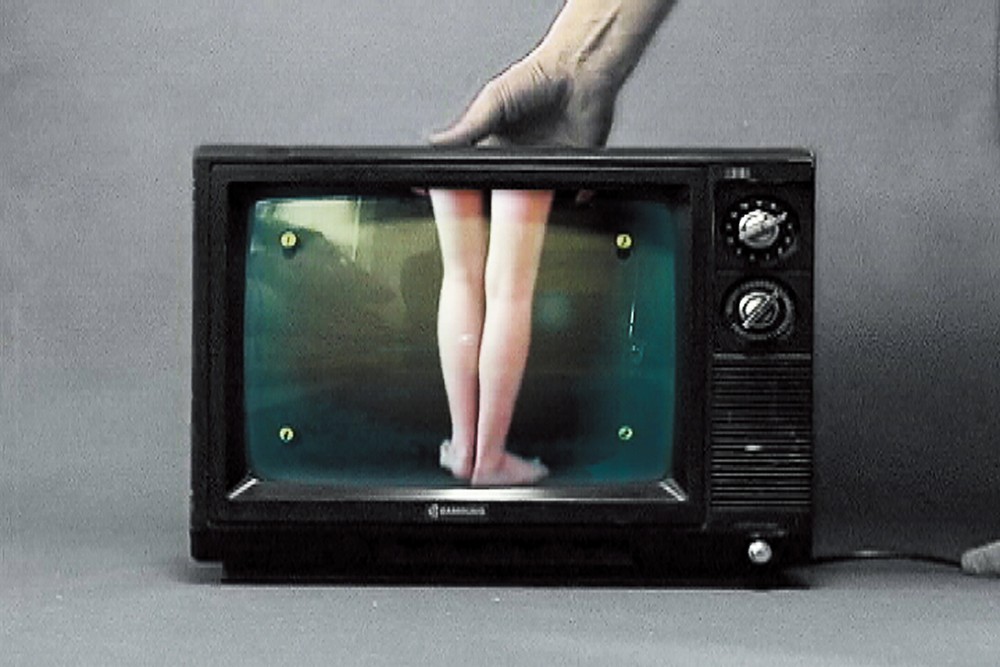
KIM Haemin_Unorderable Connections_Single-Channel Video, 6 min. 2006
KIM Haemin’s Unorderable Connections (2006) is a video work presented through an old-fashioned manually operated TV set. A man suddenly appears on the TV monitor and turns on the power manually. The image, however, does not appear properly. The man goes behind the TV to check the antenna, and soon an image appears. It shows a scene inside a subway train, where a woman is standing. Before long, however, the screen goes dark again. Apparently assuming that the TV has a faulty connection, the man gives the monitor a sharp “tap!” with his hand, and the image reappears. Soon, however, the TV picture is disrupted by interference. When the man gives the monitor another “tap!,” the woman inside the screen jerks her head backward as though she herself has been struck on the head and looks out beyond the TV screen. Then the screen goes dark once again.
KIM Haemin’s Unorderable Connections is a work that ingeniously intertwines reality and fiction. The work also addresses issues ranging from war and politics to religion. KIM approaches these political and social issues through an ingenious intercutting of scenes from films and documentary footage. For example, when gun-wielding men from the American West appear in one scene, the next cuts to Koreans during the Japanese colonial period standing with their hands raised.
As viewers watch Unorderable Connections, they are startled, intrigued, and finally burst into laughter. Why? Because, like TV Hammer and R.G.B Cocktail, Unorderable Connections is a work grounded in KIM Haemin’s remarkable analytical understanding of the mechanisms and possibilities of media.

KIM Haemin_Seeking for Love_LCD Monitor 3, Image Control Computer 1, Speaker 2_Media Installation. 2008
KIM Haemin’s Seeking for Love (2008) is a work in which three different videos are shown on three LCD monitors. The first monitor shows cars driving along a road at night; the center monitor shows a naked woman standing on a nighttime road, raising her hand as though trying to stop a passing car; and the third monitor shows a clergyman inside a church. KIM presents these three seemingly unrelated videos on separate monitors, while remaining a ‘dummy,’ leaving their interpretation entirely to the viewer.
The viewer comes to perceive the headlights of the cars traveling along the nighttime road in the first monitor as illuminating the other two monitors as well. This is because the headlights appear to cast their light onto the woman’s naked body and into the room inside the church. Exactly! KIM has synchronized the three monitors so that whenever a car passes, its headlights appear to illuminate all three screens simultaneously. In particular, the naked woman in the center monitor has her body exposed by the headlights of the passing cars.
Yet the naked woman raises her hand as though she regards the approaching headlights as a ‘helping hand of salvation.’ The car, however, simply passes her by. The viewer may therefore interpret the passing cars as ignoring the naked woman standing alone on the nighttime road and continuing on their way. In other words, the naked woman standing alone on the road is ultimately left without salvation.
The same interpretation might also be applied to the clergyman in the church. On the third monitor, the clergyman prays fervently before a red cross. Yet the red cross tilts away, suggesting that it refuses to answer his prayers, just as the cars pass by without saving the naked woman on the nighttime road. Nevertheless, both the naked woman on the road and the clergyman in the church place their hopes in each flash of light, longing for salvation whenever the light shines upon them.
What? Was the naked woman appearing on the center monitor really filmed standing on a road at night? No! The naked woman was not filmed on a nighttime road. She was filmed in a studio. KIM Haemin uses footage of a nighttime road as the background and skillfully composites the studio-filmed image of the naked woman into the foreground.
What? Did he bring a car into the studio for the shoot? Then how did he create the effect of car headlights exposing the woman’s naked body? KIM composited the naked woman in front of a streetlight on the road, manipulating the image so that her naked body appears blurred by the light - the halo - of the streetlight. He then edited the sequence in such a way that the woman’s naked body appears to be exposed by the headlights of passing cars.
What? Then are the car headlights a ‘light of hope’ - that is, a ‘light of salvation’? ‘Hope’ and ‘salvation’ seem to be two different things. This is because, in KIM Haemin’s Seeking for Love, there is a ‘light of hope,’ but there is no salvation. Regarding this point, KIM makes the following thought-provoking statement: “Seeking for Love is a work that asks whether true salvation really exists in our time.”
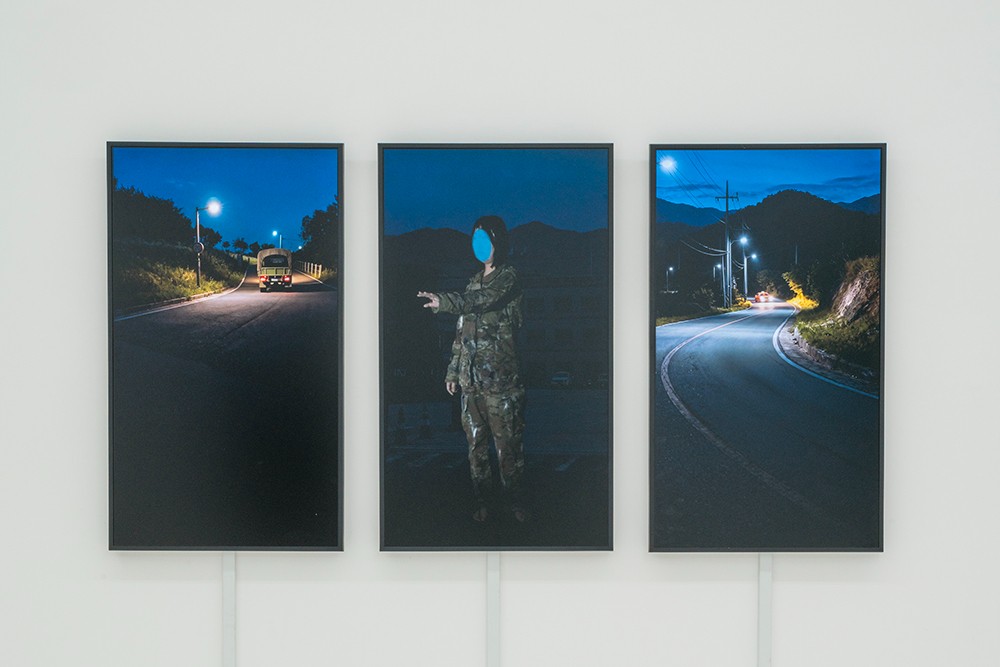
KIM Haemin_Some Pass By, Some Pause, Some Wait_3-Channel Video_12min. 30sec. 2026
For Gallery R’s special exhibition KAR, KIM Haemin presents Some Pass By, Some Pause, Some Wait (2026). The work consists of three monitors, each showing a different video. On the center monitor, a woman dressed in a worn military uniform resembling work clothes stands on a road on the outskirts of a city. On the screens to the left and right, cars appear driving along mountain roads or quiet roads in remote outdoor settings. Some Pass By, Some Pause, Some Wait can therefore be described as a video work exploring the relationship between the cars - and their headlights - appearing on the left and right screens and the woman standing in the center.
The work suddenly brings to mind KIM’s Seeking for Love (2008). In Some Pass By, Some Pause, Some Wait, the woman in military uniform, like the naked woman in Seeking for Love, raises her hand in response to the headlights of the cars approaching from either side, yet the cars simply pass her by. Whereas both the naked woman and the cars in Seeking for Love were actually filmed, Some Pass By, Some Pause, Some Wait brings together the real and the virtual. The woman in military uniform was filmed in real life, while the cars appearing on the left and right screens are AI-generated images.
Thus, in Some Pass By, Some Pause, Some Wait, a real body responds to the light of cars that never existed. In other words, the fictional cars were never actually there, yet the woman’s physical gesture of raising her hand toward them truly did take place. KIM explains that he “wanted to create a moment in which the boundary between reality and fiction briefly becomes unstable,” and adds:
“What I want to create in this work is not a single, fixed meaning. I hope that, as viewers move between the three screens, they will sense a certain space, follow the light, and look at the woman’s body, finding themselves momentarily pausing almost without realizing it. The work is both the result of what I planned and, at the same time, a trace of how that plan was transformed through its encounter with time and chance. And I believe that the moment it encounters the viewer, it will become a different work once again.”
PARK Kiwon, The Exhibition Space as Canvas
PARK Kiwon graduated from the Department of Art Education at Chungbuk National University in 1989. He works with the exhibition space itself as his canvas. His first ‘spatial work’ was presented in his solo exhibition at Gaain Gallery in 1996. For the exhibition, PARK covered all the walls of the gallery with translucent jade-green plastic sheets. In other words, he ‘wallpapered’ the exhibition space with translucent jade-green plastic. Within this jade-green space, viewers experienced “a momentary confusion and a strangeness of order felt beyond what is visible to the eye and the intrinsic properties of the object.”
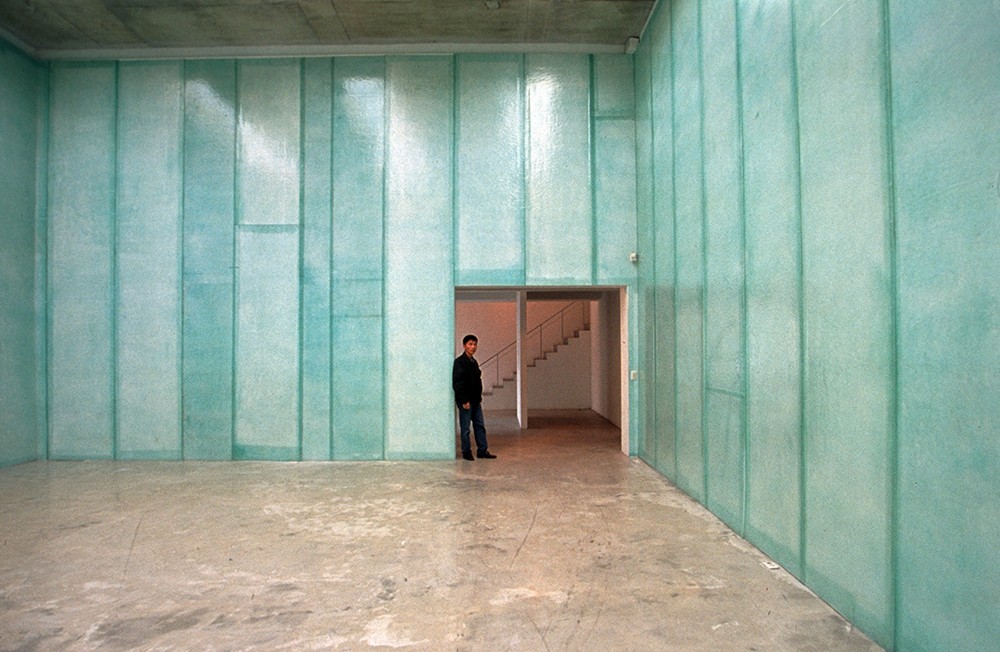
PARK Kiwon_Move_Jade-Green Translucent FRP Panels Attached to the Walls_Gaain Gallery. 1996
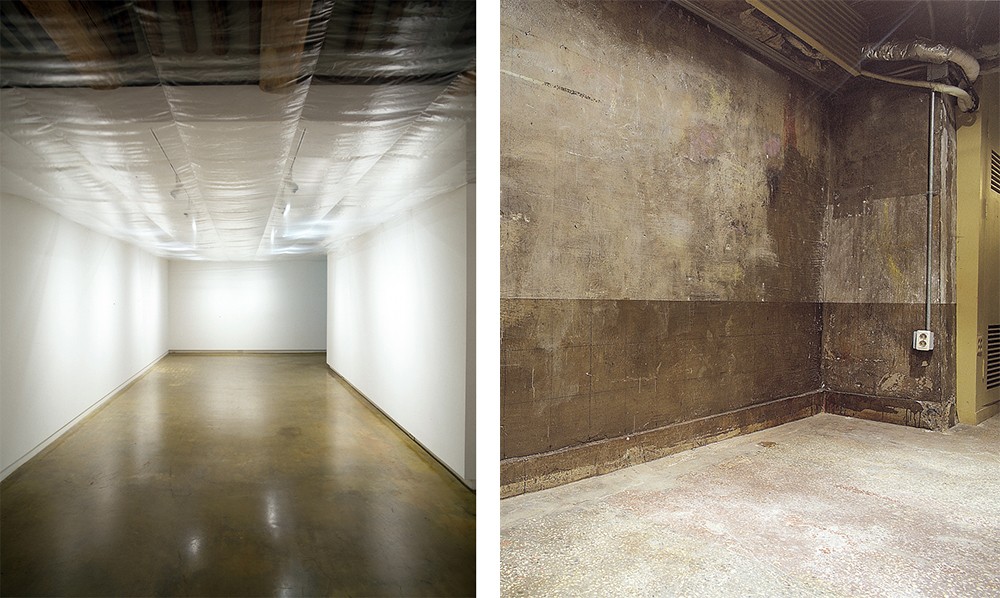
Left) PARK Kiwon_Horizontal_Transparent Vinyl_Garam Gallery. 2002
Right) PARK Kiwon_Depth_Oil-Based Clear Varnish_Sarubia Dabang. 2003
Beginning with this ‘spatial work’ at Gaain Gallery, PARK has continued to produce spatial works to this day. Among them are Volume (1997), for which he suspended translucent vinyl sheets from ceiling to floor like curtains in the exhibition space of the Centre for Contemporary Photography in Melbourne, Australia; Horizontal (2002), in which he installed sheets of vinyl across the ceiling of Garam Gallery; Hot Place (2004), for which he ‘wrapped’ not only the walls but also the ceiling of Gallery 1 at Marronnier Art Center in yellow vinyl; Reduction (2005), in which he created a kind of translucent ‘membrane’ using jade-green plastic sheets at the entrance and adjoining interior space of the Korean Pavilion at the Venice Biennale; Light Weight (2006), for which he coated the walls of the Museo Nacional Centro de Arte Reina Sofia in Spain with a yellowish, gel-like oil and installed air tubes made of yellowish vinyl on the floor; Friction (2008), in which metal rods of uniform height were installed across the entire floor of Kongkan Gallery; Floating (2009), for which air tubes were installed along the walls of the exhibition space at Miki Wick Kim Contemporary Art in Zurich, Switzerland; and Background (2010), for which he cut adhesive sheets to exactly match the dimensions of the stone slabs on the interior walls and the granite tiles on the floor of the central hall at the National Museum of Modern and Contemporary Art, Korea, painted each sheet to resemble bluish-green marble, and then covered the walls and floor with them.

PARK Kiwon_Diminish_Transparent Plastic Board_Dimensions Variable_Venice Biennale. 2005
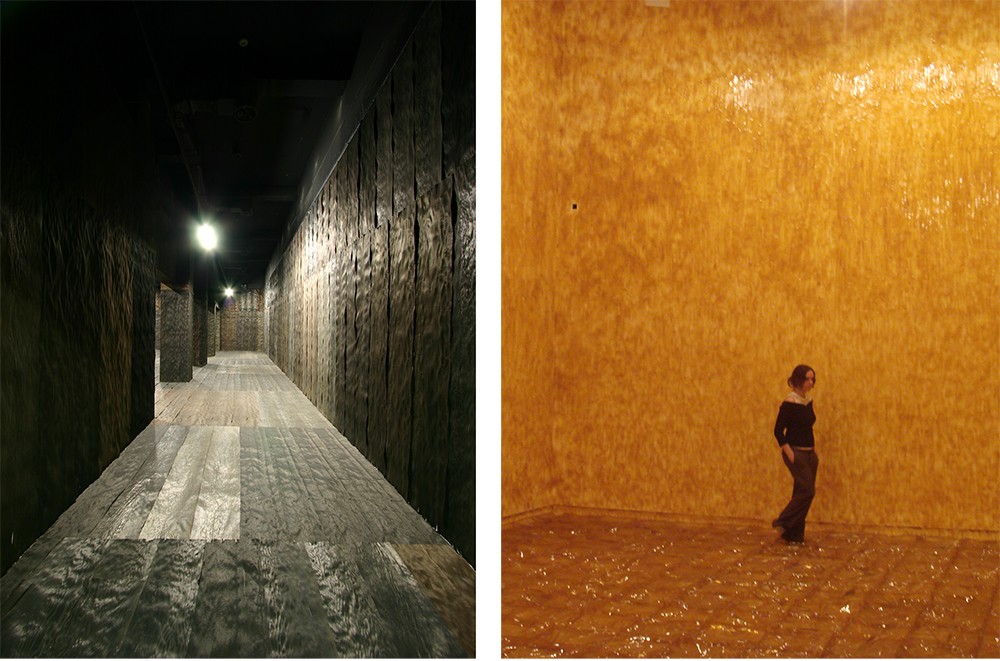
PARK Kiwon_Ruin_Ink on Wood Veneer_Dimensions Variable_Arko Art Center. 2006
PARK Kiwon_Light Weight_Industrial Oil (Grease), Air Tube_Madrid. 2006
PARK Kiwon has created remarkable works primarily using lightweight, everyday readymades with little physical volume. These include transparent yellow-colored vinyl used for garbage bags, thin metal wires like those found inside ballpoint pen refills, adhesive sheets and diagonal-striped tape, thin wood veneer and thin plastic mirrors, as well as transparent air tubes and cloth balls. He has also used transparent varnish. Beyond such physical materials, PARK has incorporated not only natural light and artificial illumination but also invisible air and wind - the movement of air - into his works. Using minimal materials in a given site and carefully considering the particular characteristics of that site, he has created installations that naturally harmonize with their surroundings.
PARK Kiwon’s ‘spatial works’ are not the kind of works likely to be enthusiastically embraced by the art market. Moreover, not only private museums but even national and public museums are reluctant to collect his installations. Yet PARK has continued to pursue the artistic practice he believes in without wavering even once. If you look through all of his works reproduced later in this catalogue, you will realize how carefully he has worked with each exhibition space given to him, making it appear ‘as spatial as a space can be.’ His subtle and delicate works could not be realized without equally meticulous thought.
More than anything, PARK has sought to offer viewers a place where body and mind can rest, as though one were lying in a field of grass; a place where one can sit or lie down and rest for a while; and a place where one can sense the vast and endless journey of life.
Of course, PARK Kiwon is not content simply to provide viewers with a ‘place of rest.’ This is because his works cannot be fully understood without careful contemplation. His works are like elegant swans gliding across a lake: beneath the surface, they must keep ‘paddling’ ceaselessly. His extraordinary installations are realized only at the cost of an almost unimaginable amount of ‘labor.’
Looking at PARK Kiwon’s works, I found myself wondering whether there could be any other works that express the diverse and subtle dimensions of human perception with such simplicity. The PARK Kiwon I have come to know is a perfectionist. He devotes himself entirely to achieving a single perfect moment. This is because his installations exist only for a fleeting moment. In other words, they remain on view for a certain period of time and then disappear.
I imagine PARK watching his own work being dismantled after an exhibition has ended. The word ‘ephemerality’ comes naturally to mind.
Of course, alongside his ‘spatial works,’ PARK Kiwon has also continued to produce two-dimensional works. For Gallery R’s special exhibition KAR, he presents four works from his Width series, executed in oil on canvas, as well as his ‘furniture-works.’ The origins of his Width series can be traced back to his solo exhibition at the Kumho Museum of Art in 1994. At the time, he exhibited five works from his Black Drawing series and five works from his Geometrical Drawing series.
His Black Drawings were executed with black-toned oil paint on full-sheet printmaking paper. Rather than depicting anything in particular, however, they might be described as a kind of ‘monochrome painting’ in which virtually nothing is represented. While the Black Drawings were created by applying thick vertical strokes of black-toned oil paint to printmaking paper with a broad flat brush, almost as though priming the surface, his Geometrical Drawings consisted of geometric forms drawn with black oil stick and colored pencils on large sheets of hanji measuring approximately 100-ho in size. These Geometrical Drawings would later develop into his Width series. In this sense, the origins of PARK Kiwon’s Width series can be traced back to 1994.
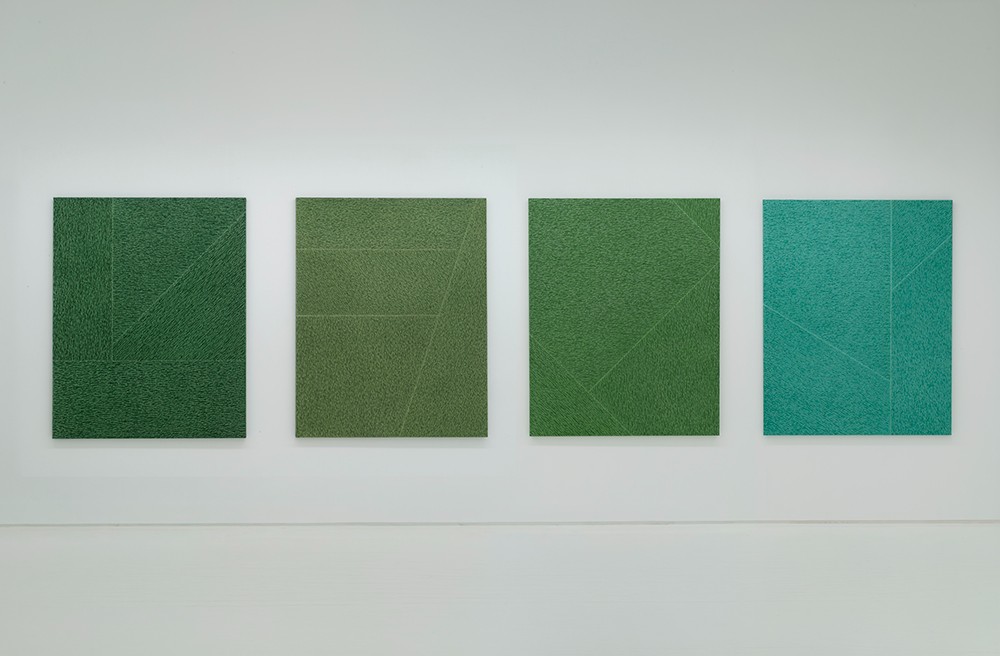
PARK Kiwon_Width 47_Oil on Canvas_162×130cm. 2026
PARK Kiwon_Width 48_Oil on Canvas_162×130cm. 2026
PARK Kiwon_Width 49_Oil on Canvas_162×130cm. 2026
PARK Kiwon_Width 50_Oil on Canvas_162×130cm. 2026
Some works in PARK Kiwon’s Width series are painted in oil on hanji, while others are executed in oil on canvas. Beginning in 2007, he started working with thick, stiff oil paint from which much of the oil had been removed. The works from his Width series presented at Gallery R on this occasion are executed in oil on canvas. In an interview with a media outlet, PARK described the Width series as follows:
“In these paintings, I broadly divided a particular place within a space into several planes, then completed each plane by repeatedly applying and overlapping small lines in different directions. The flow of color is centered primarily on shades of green, which I think originated from my consideration of the four seasons of nature. I sought to embody my interests in place, empty space, and circularity on the flat surface of paper.”
At first glance, PARK Kiwon’s Width series appears almost as though geometric forms had been drawn in pastel on hanji. But if you take a step closer into the painting, you will discover that it is actually painted in oil on canvas. And if you take one step further into his Width series, you will begin to discover countless lines within the geometric forms. Exactly! They are lines drawn with a fine brush. The lines intersect and overlap.

Left) PARK Kiwon_Small Shelf_Galvanized Steel_600×200×300mm(h), 2t. 2022
Right) PARK Kiwon_Desk [Table]_Galvanized Steel_900×600×750mm(h), 2t. 2022
Now, let us turn to PARK Kiwon’s ‘furniture-works.’ His Desk [Table] (2022) is a sculpture made of galvanized steel that, as the title suggests, can also function as an actual desk or table. Likewise, his Small Shelf (2022) is a sculpture made of galvanized steel that can also be used as a shelf, just as its title suggests. Regarding his ‘furniture-works,’ PARK explains:
“I had wanted to make ‘furniture’ works for a long time, because furniture has qualities that lend themselves particularly well to a minimalist approach.”
I call PARK Kiwon’s ‘furniture-works’ Living Furniture. Living Furniture is a term I coined by combining conventional ‘home furniture’ with what is known in the field of craft as ‘art furniture.’ In this sense, Living Furniture is a kind of ‘furniture-work’ that restores the ‘function’ that has been lost from everyday life. It is both a household object and a work of art - something that lives and breathes within everyday life.
PARK Kiwon’s Living Furniture can also be understood in relation to his Public Furniture. The term Public Furniture combines what urban studies refers to as ‘street furniture’ - such as mailboxes, public telephones, public restrooms, bus stops, planters, and fountains - with what is commonly referred to in the art world as ‘public art.’
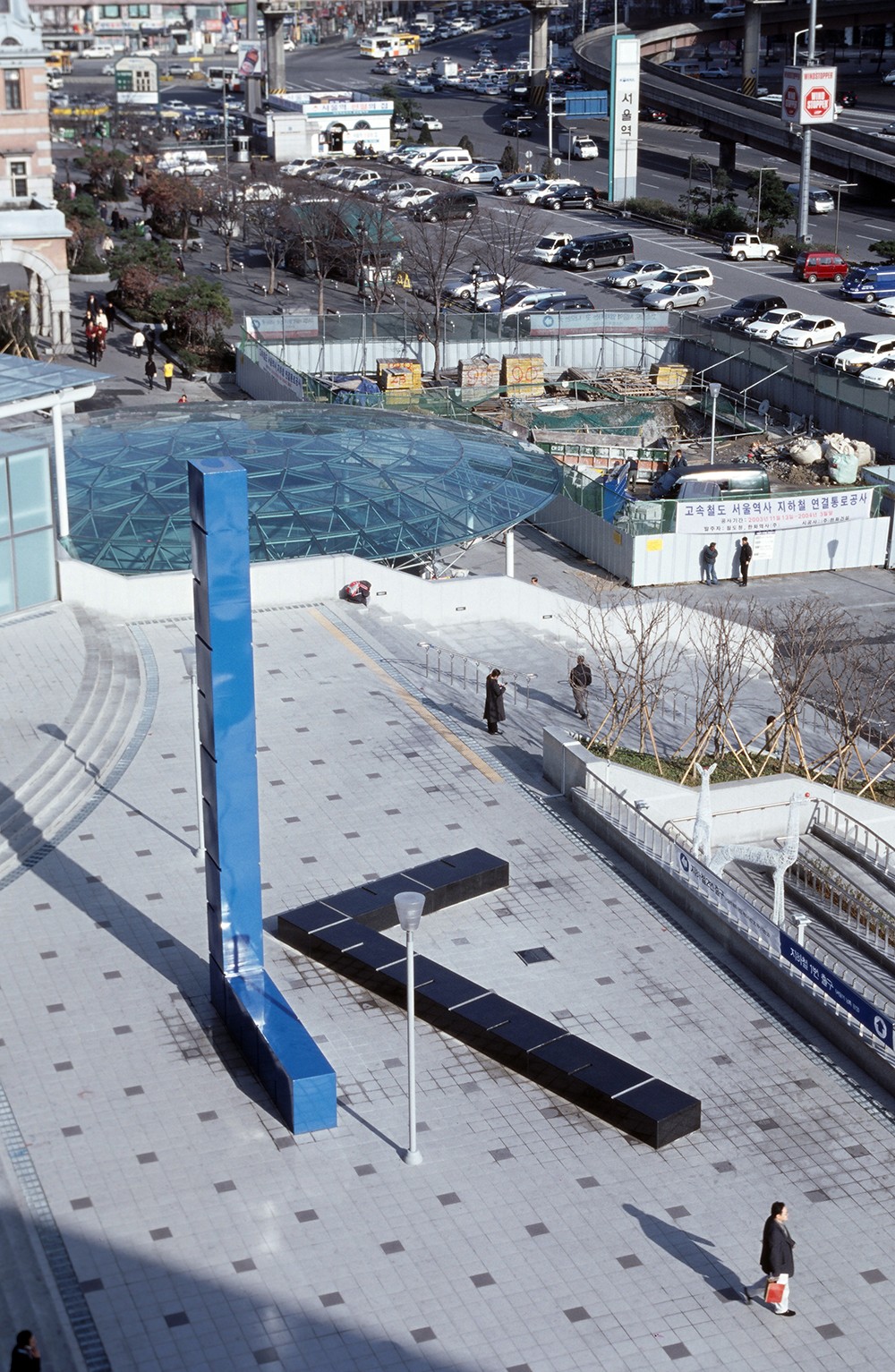
PARK Kiwon_Ruler-Width_Paint on Stainless Steel, Black Granite. 2003
PARK Kiwon’s Ruler-Width (2003) can be cited as an example of his Public Furniture. The work was installed as a public artwork in 2003, when the new Seoul Station for high-speed rail, constructed primarily of glass and steel, was completed. It consists of two monumental L-shaped, ruler-like sculptural forms: one blue and the other black. The blue ‘L’ is a stainless-steel sculpture measuring 10 meters high and 5 meters long, while the black ‘L,’ identical in size and shape, is made of black granite and laid flat on the ground. PARK’s Ruler-Width can therefore be understood as a monumental enlargement (10×5m) of the familiar right-angle ruler.
I still regard Ruler-Width as a radical work of public art. When we consider the site in which it was installed, we can understand why the artist adopted the form of a right-angle ruler, a symbol of ‘precision and rigor.’ Yet PARK does not limit the work merely to site and meaning. He goes one step further. Interestingly, far from declaring “Do Not Touch!,” Ruler-Width instead offers itself to the weary passerby as an empty chair - a place to sit and rest.
KIM Taeheon’s “One Thousand and One Paintings”
In 1993, the year that marked the end of military rule and the inauguration of a civilian government in Korea, KIM Taeheon held his first solo exhibition, Finding Hidden Pictures in ‘Hidden History’, at Samjeong Art Museum. In 1994, he was selected for An Artist to Watch, an exhibition of promising artists chosen by art critics, held at Dong-A Gallery. In 1998, he attracted attention in the art world with Destruction and Creation of Space: Between Seongnam and Bundang (Sungkok Art Museum / Artists of Tomorrow).

KIM Taeheon_Destruction and Creation of Space: Between Seongnam and Bundang_Sungkok Art Museum. 1998
In 2001, KIM Taeheon held a solo exhibition titled Hwananjungilgi (畵亂中日記) at Project Space Sarubia. Nanjung Ilgi (亂中日記, War Diary) is the diary written by Admiral Yi Sun-sin while serving with his troops during the seven years of the Imjin War (1592-1598). In other words, it is a diary written in the midst of war. KIM, however, added the Chinese character hwa (畵), meaning ‘painting,’ to Nanjung Ilgi, transforming the historical title into Hwananjungilgi (畵亂中日記).

KIM Taeheon_Hwananjungilgi (畵亂中日記)_Installation View at Project Space Sarubia. 2001
Korea in 2001 was not at war; it was under the KIM Daejung administration, known as the ‘Government of the People.’ The administration, however, had inherited the aftermath of the IMF foreign exchange crisis that erupted toward the end of the preceding civilian government. The crisis was described as “the greatest national crisis since the Korean War.”
Yet within three years, in December 2000, President KIM Daejung officially declared that Korea had “completely overcome the IMF foreign exchange crisis.” In August 2001, Korea fully repaid the total USD 19.5 billion in IMF bailout funds and officially ‘graduated’ from the IMF assistance program. Overcoming this national crisis - the economic crisis - has therefore been regarded as one of the greatest achievements of the KIM Daejung administration.
This recovery, however, was not without its repercussions. In the wake of the foreign exchange crisis, the once-familiar notion of lifetime employment largely disappeared from Korean society, while early and involuntary retirement contributed to the collapse of a considerable number of middle-class households.
KIM Taeheon’s Hwananjungilgi is a ‘picture diary’ that he painted?and wrote?between 1999 and 2000, when Korea was going through a period of severe economic hardship. His solo exhibition Hwananjungilgi attracted considerable attention from the Korean art world at the time. In an era when most artists dreamed of creating monumental works and painted on enormous canvases, KIM’s paintings were refreshingly unconventional: he worked on small No. 1 canvases, painting on them as though he were writing a diary.
KIM Taeheon is known in the Korean art world as a “drawing artist.” The origins of his drawing practice can be traced back to Destruction and Creation of Space, held at the Sungkok Art Museum in 1998. The exhibition included drawings he had been making since graduating from art college - mostly small-scale works drawn freely and spontaneously, almost like doodles. He has continued this drawing practice consistently ever since, right up to the present day.
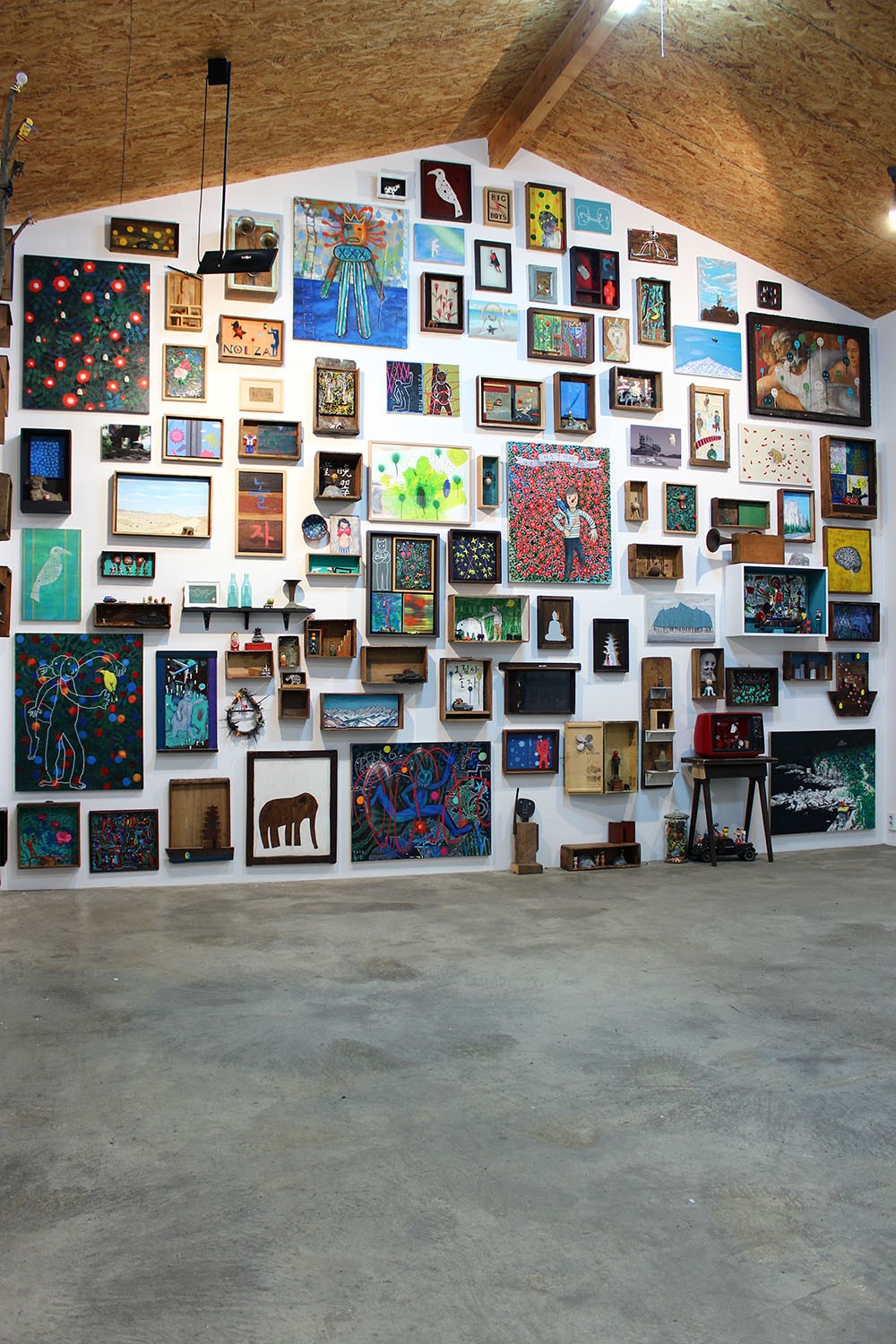
KIM Taeheon_Jamhwa (箴畵)-BIG BOY_Space Mom Museum of Art. 2016
In 2016, KIM Taeheon presented nearly 390 works in his solo exhibition Jamhwa (箴畵)_BIG BOY at Space Mom Museum of Art. For the exhibition, he virtually ‘wallpapered’ the gallery walls with his works. Filling the walls from end to end, the works varied widely in scale and medium, ranging from small paintings on No. 1 canvases to paintings as large as No. 30, as well as works combining painting with objects and photographic works.
KIM Taeheon’s Usefulness of the Useless - Drawing series consists of works that bring together painting, drawing, and objects. He collects discarded objects deemed useless, dusts and cleans them, takes them apart and reassembles them, and then paints on them, transforming the useless into something useful. His Usefulness of the Useless series can be understood as an attempt to reveal a broader historical terrain concealed beneath the superficial images of our time, within a political and economic landscape that cuts across the boundaries between ‘high art’ and ‘popular culture.’
Looking at KIM Taeheon’s works, I suddenly found myself thinking beyond ‘hybrid martial arts’ to ‘mixed martial arts.’ As you know, ‘hybrid martial arts’ refers to combat between practitioners of different martial arts disciplines. ‘Mixed martial arts,’ by contrast, involves fighters with a comprehensive understanding of multiple martial arts disciplines competing against one another. KIM Taeheon is likewise an artist with a multifaceted understanding of diverse artistic genres. His works bring together drawing and painting, printmaking and photography, as well as objects and text. I therefore call his practice a kind of mixed material arts.
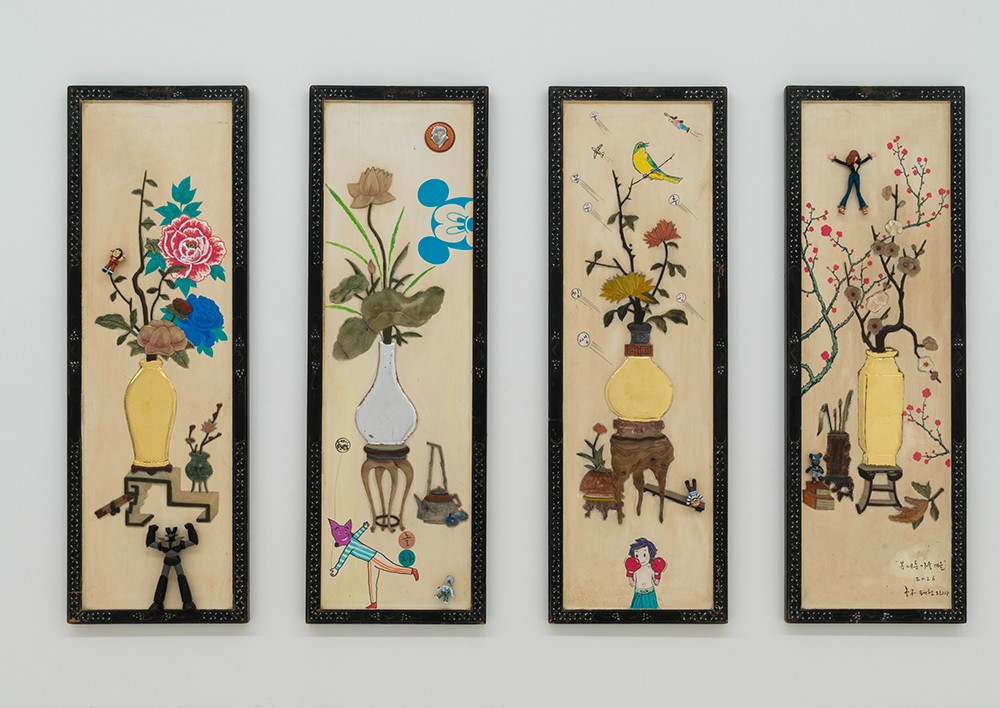
KIM Taeheon_Spring, Summer, Autumn, Winter_Silver and Gold Leaf, Objects, and Acrylic on Jade Folding Screen_30.5×91.5cm. 2026
For Gallery R’s special exhibition KAR, KIM Taeheon presents One Thousand and One Paintings (千一夜畵) and the four-panel work Spring, Summer, Autumn, Winter (2026). HWANG Youngbae, Director of Gallery R, purchased a decorative four-panel folding screen made by an unknown artist from an acquaintance. I then passed the screen on to KIM Taeheon and asked him to practice gapil (加筆) - the act of adding to, erasing, or altering an existing work with one’s own brush.
KIM added his characteristic humor to the decorative four-panel screen. On its four jade panels, he painted with acrylic, incorporated various objects, and covered the vases with silver and gold leaf. He then titled the work not The Four Gentlemen (四君子), as one might expect, but Spring, Summer, Autumn, Winter. Let us hear KIM explain it in his own words:
“The reason I titled the work Spring, Summer, Autumn, Winter is as follows. From left to right, I imagined the peony as spring, since it blooms in late April; the lotus as summer, since it blooms from late July to early August; the chrysanthemum as autumn, since it blooms in October; and the plum blossom as winter, thinking of seoljungmae - plum blossoms blooming amid the snow in early spring. It purely reflects the seasons as I experience them at home. There are no orchids or bamboo - the traditional subjects of the ‘Four Gentlemen’ - in this painting.”
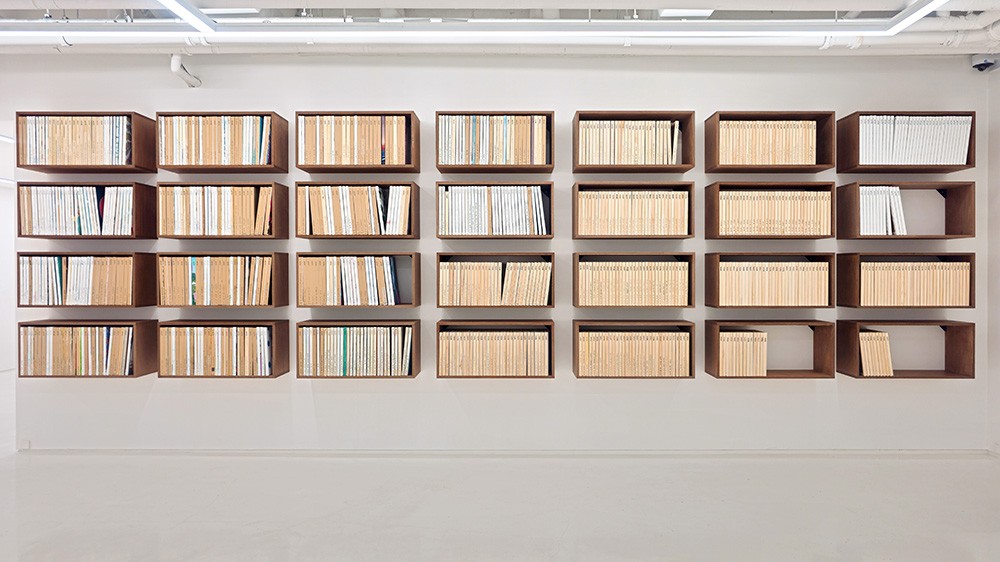
KIM Taeheon_One Thousand and One Paintings (千一夜畵)_659 No. 4 Paintings on 28 Painting Racks_Installation View at Gallery R. 2026
Now, let us turn to One Thousand and One Paintings (千一夜畵). As you may know better than I, One Thousand and One Nights (千一夜話) is also known as The Arabian Nights’ Entertainment. The story begins when the maiden Scheherazade marries King Shahryar. Shocked by his queen’s infidelity, the king takes a virgin to his bed each night and has her put to death at dawn. To escape the same fate, Scheherazade tells the king a story every night. The king becomes captivated by her fascinating tales, which continue night after night. Moreover, Scheherazade deliberately leaves each night’s story unfinished, compelling the king to postpone her execution so that he can hear the rest. Her storytelling continues for one thousand and one nights. In the end, the king and Scheherazade live out the rest of their lives happily together.
Speaking of his own One Thousand and One Paintings (千一夜畵), KIM Taeheon says, “These are not the stories Scheherazade told King Shahryar over one thousand and one nights when her life was at stake after spending each night with him.” He continues, “Unlike One Thousand and One Nights (千一夜話), my One Thousand and One Paintings (千一夜畵) has never involved risking my life, nor has there been any need to do so.” His One Thousand and One Paintings is a kind of “one-thousand-painting project,” through which he aims to create one thousand paintings on No. 4 canvases. For the present exhibition, he has arranged 659 of these No. 4 paintings on twenty-eight painting racks.
Why, then, has KIM placed the paintings on racks rather than displaying them on the walls? If all 659 works had been hung across the gallery walls, would viewers not find themselves bewildered as to how they were supposed to look at so many works? Has he arranged them this way, then, out of consideration for viewers, allowing them to take the paintings from the racks one by one and look through them as though peeling away the layers of an onion?
If you were to take out and look through every one of KIM Taeheon’s One Thousand and One Paintings placed in the twenty-eight racks, you would discover paintings concerning his family, friends, and colleagues, as well as countless unidentified people. You would also come to realize that his One Thousand and One Paintings reflects his own ‘point of view’ on society, politics, the economy, and culture at large. If so, might his One Thousand and One Paintings ultimately be a kind of ‘monumental self-portrait’?
AHN Sihyeong’s “Works That Are Both Enigmatic and Approachable”
AHN Sihyeong graduated from the Department of Fine Arts at Dong-eui University in 1995 and from the Graduate School of Formative Arts at Yeungnam University in 2001. His signature works, commonly referred to as his ‘Stone’ works, began in the mid-1990s, after he graduated from the Department of Sculpture at Dong-eui University, and he continued working on the series through 2010. In 1995, he submitted a ‘Stone’ work to the Grand Art Exhibition of Korea, followed by another to the Korea Young Art Festival in 1996.
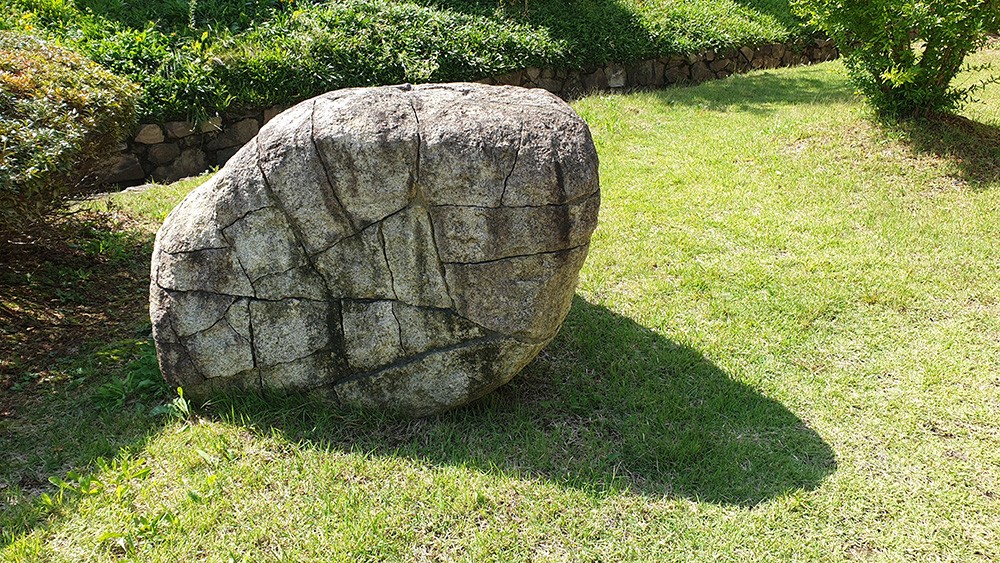
AHN Sihyeong_Breathing Stone_Granite_1998
In 1997, AHN was invited to participate in the Asian Contemporary Sculpture Exhibition, and in 1998, to the Korea Young Artists Biennale. In 2000, he received an award at an international stone sculpture competition in Hyogo Prefecture, Japan, where he created Creation and Breathing, a 2.4-meter-high granite sculpture made by splitting a block of granite and then joining the pieces back together, which remains at a sports park on Awaji Island. In the same year, he was invited to the Sarajevo Winter Festival in Bosnia and held his first solo exhibition.
In 2001, AHN Sihyeong was invited to participate in the Hualien International Stone Sculpture Exhibition in Taiwan. In 2004, he was invited to Crossing Time, Crossing Spaces in Poznań, Poland, and to the MMAC Festival in Tokyo. In 2006, he participated in the Busan Biennale Sculpture Project together with MOON Byungtak and PARK Bonggi. He subsequently presented works from his ‘Stone’ series at the Incheon Women Artists’ Biennale in 2009 and the Incheon International Digital Art Festival in 2010.
For ten years, AHN Sihyeong quietly and consistently pursued the so-called ‘Stone’ works that he had begun in the mid-1990s. His ‘Stone’ works, commonly known as the Breathing Stone series, involved breaking stones apart and then ‘remaking’ them into stones. After more than a decade of sustained practice, his Breathing Stone series evolved in 2007 into what he called Making River Stones. For this project, AHN would bring broken or damaged stones found along roadsides back to his studio and ‘heal’ them by carefully working their surfaces with a grinder and sandpaper. After healing the wounded stones, he would return them to the riverside. This is why he calls this practice Making River Stones.
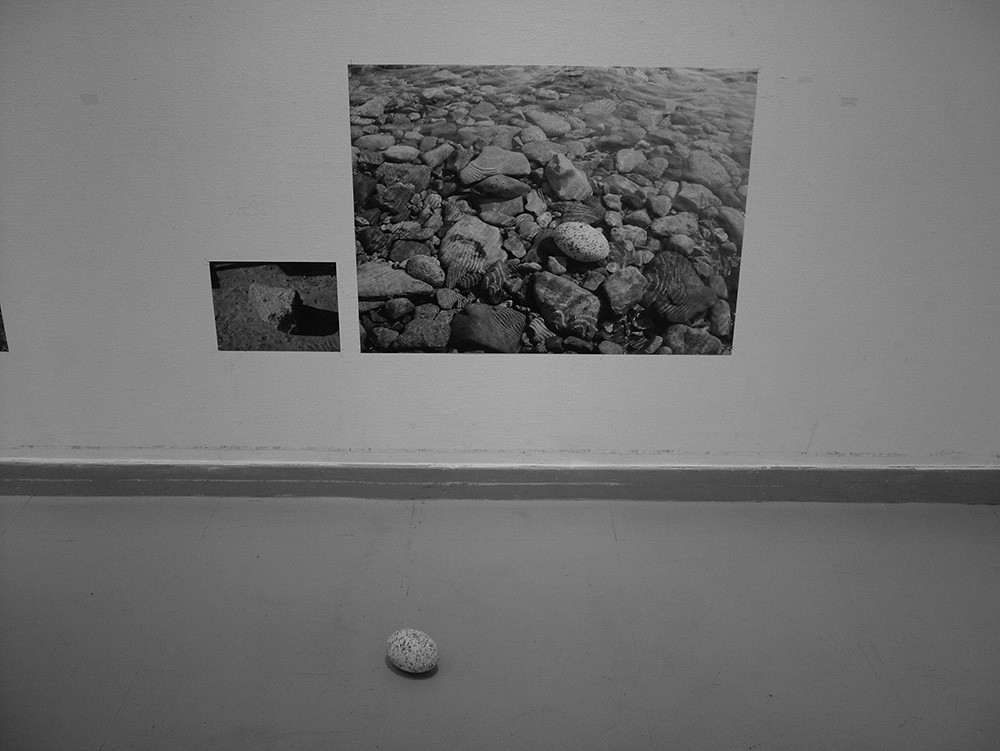
AHN Sihyeong_Making River Stones_Stone, Photograph. 2007
At first glance, AHN Sihyeong’s ‘Stone’ works appear as though virtually nothing has been done to them. Yet if you examine his working process, you will realize just how much time and labor he devoted to making them. In a word, his practice can be described by the classical expression jeolchatakma (切磋琢磨) - the process of cutting, filing, carving, and polishing something through painstaking effort. If you happened to encounter one of AHN’s Making River Stones works by a river, you would probably regard it as ‘just’ another stone found along the riverbank. This is because the stone appears simply to have always been there, just as it is.
If so, is AHN Sihyeong’s Making River Stones not a radical work? Even if you encountered one of his Making River Stones works somewhere along a riverbank, chances are you would never recognize the stone as a ‘work of art.’ If Duchamp’s “readymade” represented the radical art of the twentieth century, might AHN Sihyeong’s Making River Stones represent the radical art of the twenty-first century? For if the radical art of the twentieth century revolved around the question, “Is it a work of art or not?”, the radical art of the twenty-first century might instead ask, “Where on earth is the work of art?”
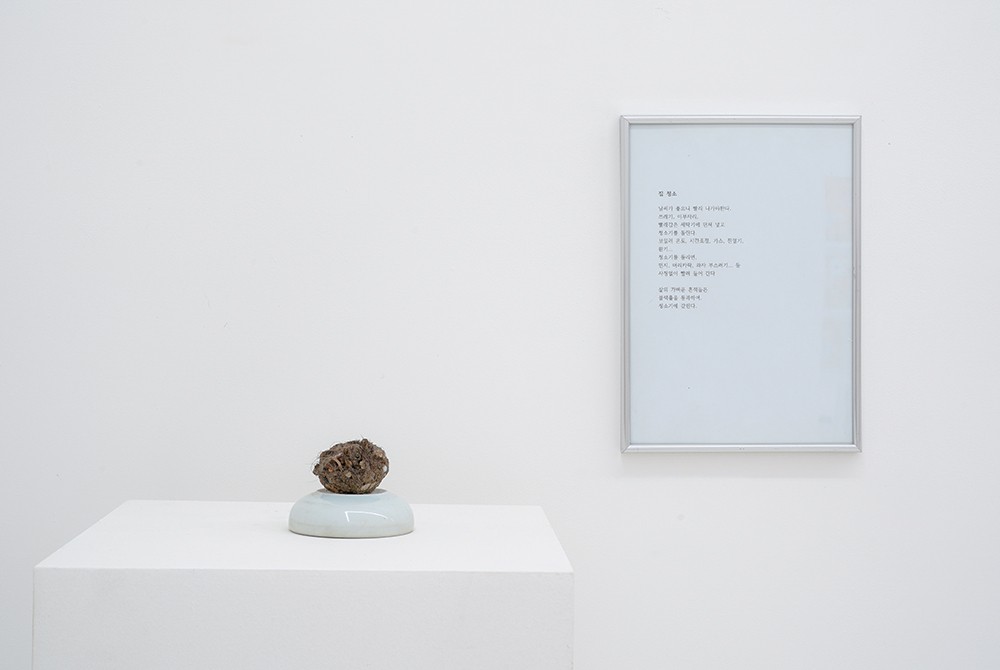
AHN Sihyeong_Dust Sculpture_Dust, Ceramic Bowl. 2011
Beginning in 2008, AHN Sihyeong began experimenting with a new body of work. It grew out of his reflections on his own life surrounded - and almost buried - by everyday objects. These works include Nails (2008), for which he collected bent nails left behind after burning wood in his home boiler, brought them to his studio, and straightened them; Satellite City (2008) and Finding the Way (2011), made with circuit boards that fascinated him after he opened the case of a broken computer; Black Orchid (2011), made with black plastic cable ties normally used for temporary fastening; Dust Sculpture (2011), made by mixing dust collected from his vacuum cleaner after cleaning his house with adhesive and allowing it to harden; and Maebyeong (2012), made from PET bottles discarded after being used in his home.
Beginning in 2013, AHN took this practice a step further and began creating what he calls the Sayeon (事緣) series, consisting of everyday objects accompanied by texts. For example, he exhibits mass-produced “readymades” - including wall clocks, matchboxes, fans, vinyl records, stamp albums, cigarettes, coffeehouse lighters, piggy banks, and black-and-white television sets - together with texts recounting the sayeon, or stories and circumstances, associated with each object. AHN describes his Sayeon series as follows:
“My Sayeon series is about oblivion, using objects that are gradually disappearing from our lives. The sad objects in my studio, covered in dust, seem to whisper something to me. A TV, an electric fan, a radio, a wall clock, a vacuum cleaner, a gas stove, hair clippers, cigarettes, matches, English study guides from middle and high school, bags, an insulated lunchbox, pencils, erasers, notebooks, rulers, Jinro Tourist Soju, Napoleon, champagne, Joker, tonic water... and other small and insignificant yet potentially meaningful objects. There are also photographs filled with memories of raising my two sons up until around the time they entered elementary school, their scribbles from kindergarten, toys, Yu-Gi-Oh! cards... things like these.”
Disappearing objects. They are things AHN Sihyeong once used in the course of his everyday life. By now, however, they are objects that have lost their use value. And yet AHN places these objects, stripped of their use value, on his own inventory of possessions. The disappearing objects listed in AHN Sihyeong’s inventory may seem insignificant to you, but to him, at least, they are “precious things.”

AHN Sihyeong_Wall Clock_Wall Clock, Text. 2014
As a specific example, let us look at AHN Sihyeong’s Wall Clock (2014). The work consists of an old wall clock and a text. It is an old-fashioned mechanical wall clock: when its cover is opened and its mainspring wound, it marks the passage of time with a steady tick-tock. Of course, it also chimes every hour. But this wall clock has stopped. Could it be because no one has given it its ‘food’? Beside the Wall Clock, AHN presents the following text:
My father worked for the Monopoly Bureau. Until he bought an automatic wristwatch that wound itself with the movement of his arm, he would take turns ‘feeding’ the wall clock and his wristwatch by winding them, and he would carefully reset the wall clock whenever it began to run a little slow. It was important for my father to arrive at work on time. Our family’s livelihood depended on it.
I was a heavy sleeper, and I often woke to the sound of the clock chiming while I slept. On Sundays, I would sleep until nearly noon. I could have slept longer, but when the clock struck twelve times, half asleep I would count, ‘One, two, three...,’ thinking that I only had to endure a little longer, and by then I would be wide awake.
When I had to go to the post office early in the morning or at dawn to buy stamps, my father was my clock. I had no need for a clock of my own, much less a wall clock. The ticking of the second hand sounded so loud that it actually kept me from falling asleep, and whenever I tried to take a nap during the day, the clock seemed to chime all too often.
The movement of the clock’s hands accompanied my father throughout his arduous life. And when my father passed away, the clock stopped as well.

AHN Sihyeong_Traces on White_White Styrofoam, Text_26×3×37cm. 2026
For Gallery R’s special exhibition KAR, AHN Sihyeong presents twelve works from his series. Here, I will briefly introduce just two of them: Traces on a White Ground (2026) and Black Mirror II (黑鏡 2) (2026).
Traces on a White Ground consists of a piece of white Styrofoam and a text. What on earth is the artist trying to convey to viewers through this piece of white Styrofoam? Let us read the text AHN presents alongside it.
Traces on White
In a sunny spot,
at the corner of a building,
an elderly woman sits,
waiting for the shuttle bus.
When I return
after using the restroom,
the woman is gone,
and the Styrofoam
is blowing in the wind.
Suddenly, Kazimir Malevich’s White on White (1918), in the collection of the Museum of Modern Art in New York, comes to mind. The painting depicts a white square, slightly off-center and tilted toward the upper part of another white square. AHN Sihyeong’s Traces on White, however, consists of the piece of white Styrofoam on which an elderly woman had been sitting while waiting for the shuttle bus. When AHN returned from the restroom, the woman had already boarded the shuttle bus and left, while the piece of white Styrofoam was blowing in the wind. AHN caught hold of it. Traces of the elderly woman remained on its white surface.
Suprematism, founded by Malevich in 1915, was an early twentieth-century Russian avant-garde movement that rejected the representation of objects from the visible world in favor of expressing pure feeling through basic forms and colors. Seeing the piece of white Styrofoam bearing traces of the elderly woman, AHN was reminded of Malevich’s Suprematist painting White on White and created Traces on White. In Malevich’s White on White, traces of the artist remain in the form of his brushstrokes. In AHN Sihyeong’s Traces on White, however, what remains is not the trace of the artist, but only the trace of the elderly woman.

AHN Sihyeong_Black Mirror II (黑鏡 2)_Tablet, Text_12.7×21.8cm. 2026
AHN Sihyeong’s Black Mirror II (黑鏡 2) consists of a tablet and a text. What on earth is the artist trying to convey to viewers through this tablet? Let us read the text AHN presents alongside it.
Black Mirror II
Among Mr. Doo’s odds and ends,
an ownerless tablet
was soaked by the rain, dried out,
and soaked again.
I plugged in a charger.
It seemed faintly to come back to life,
then died.
On the darkened screen,
I see myself.
Mr. Doo is a man who displays and sells miscellaneous secondhand objects in a corner of a parking lot in Yeongju. AHN Sihyeong purchased from him a tablet that had repeatedly been soaked by the rain and dried out. After returning home, AHN plugged a charger into the tablet. At first, it seemed faintly to be charging, but then it died. In the black screen of the dead tablet, AHN saw his own reflection. He named the dead tablet Black Mirror (黑鏡). Heukgyeong (黑鏡) literally means ‘black mirror.’
This suddenly brings to mind the famous British science-fiction anthology series Black Mirror. The title Black Mirror derives from the resemblance of the dark, inactive screens of smartphones, televisions, and monitors to “black mirrors.” The series casts a dark and incisive eye on the ways advanced technologies can transform and disrupt human lives and society.
AHN Sihyeong’s Black Mirror II, however, does not so much symbolize our dark desires reflected on the reverse side of advanced technology - the tablet - as reveal who we really are. Or might it be said that, in this “black mirror,” what we ultimately encounter is our true selves?
Some people call AHN Sihyeong’s ‘texts’ literature or poetry. Yet his ‘texts’ are far removed from ‘made-up’ literature or ‘cosmetically altered’ poetry. AHN’s ‘texts’ are simply writing - nothing more. His writing is plain and unpretentious, simple enough for even an elementary school student to understand. There is no artifice in it. His writing is straightforward and restrained. Yet although simple and understated, it is written with remarkable density.
If AHN Sihyeong’s Traces on White and Black Mirror II were exhibited solely as objects - the Styrofoam and the tablet - without their accompanying texts, viewers would probably find them enigmatic. Once they read his texts, however, anyone can relate to the works. His works can therefore be described as at once among the most enigmatic and the most approachable. It is precisely in this respect that I regard AHN Sihyeong’s Sayeon series as a radical body of work in the wake of Marcel Duchamp’s “readymades.”
CHANG Jia’s “The Power of the Weak”
CHANG Jia majored in media art at Korea National University of Arts, completing her undergraduate studies in 2001 and her graduate studies in media art there in 2004. One of CHANG Jia’s representative bodies of work is the Physical Conditions for Becoming an Artist series. The series consists of video works she created in 2000 while studying media art at Korea National University of Arts.
As the “physical conditions for becoming an artist,” CHANG identifies “endless patience,” “enjoying every situation,” “setting the target precisely,” and “responding proactively.” Her Physical Conditions for Becoming an Artist can therefore be understood as a kind of “attitude toward becoming an artist.”
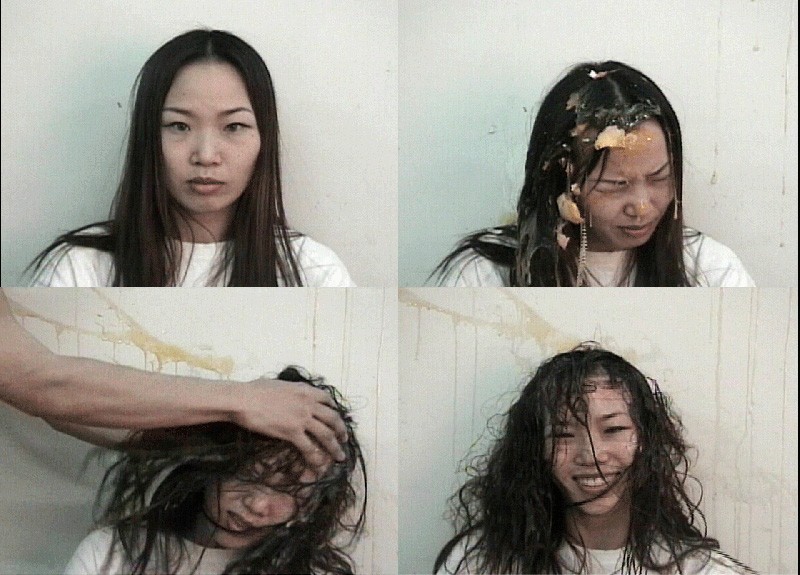
CHANG Jia_Physical Requirements for Being an Artist: 2nd-Enjoy Yourself in Every Condition!_Single-Channel Video, 3 min. 30 sec. 2000
Remarkably, CHANG Jia had already established her own “attitude as an artist” while still an art student. To this day, she has remained faithful to the attitude she formed during those years, pursuing a distinctive artistic practice of her own. If I were to choose the words that run through the entire body of her work, they would be ‘pain and pleasure.’ CHANG focuses on the ‘body’ as a medium through which pain and pleasure are conveyed. In an interview, she described this aspect of her practice as follows:
“As a transgressive agent acting through the body, I place the body within the social system - as a site where events unfold and as a medium for conveying narratives - bringing with it various bodily fluids, sensations involving all five senses, and feelings of discomfort and fear, and casting all of these into a social system that is rigid, or that we believe to be rigid.”
In 2000, CHANG began, one by one - as though peeling away the layers of an onion - to expose what had been tacitly regarded as taboo and to undertake seemingly impossible missions. Her first mission was Self-Portrait, which she referred to as ‘becoming a crazy woman.’ The work consists of photographs and video edited from a performance in which CHANG walked through the streets at 4:30 in the morning with her breasts exposed.
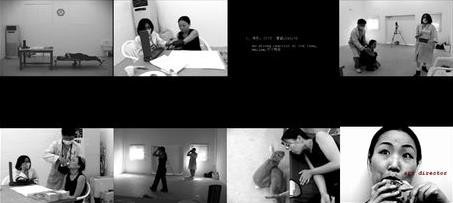
CHANG Jia_Abnormal Changes in the Senses by Drug Abuse_Single-Channel Video. 2002
Beginning in 2002, CHANG Jia began to focus intensively on producing single-channel video works. Her Abnormal Changes in the Senses by Drug Abuse (2002) is a kind of ‘medical experiment’ video documenting the physical changes experienced by a woman under the influence of drugs. The work exposes how the patient - the artist herself - is distorted and controlled by the social system.
In Picnic (2003), grotesque characters appear intent on “punishing those who have been conditioned by life,” subjecting the protagonist to a series of ordeals, while a mysterious photographer obsessively takes pictures of these seemingly inexplicable scenes, ultimately throwing the order of everyday life into complete disarray. In Flower Stamp-Blood Drop (2004), a shabby office suddenly turns into the Garden of Eden, where a low-ranking female employee and her male superior confront each other naked, like Adam and Eve. Instead of sharing the forbidden fruit, however, they eat seonji (congealed animal blood); when the woman spills the seonji beneath her, it is transformed into menstrual blood. In Princess Said (2004), the tears of a male slave who has become a woman’s sexual plaything are collected and used to nourish the plants in her garden. These works were screened not in a museum or gallery, but at Seoul Art Cinema.
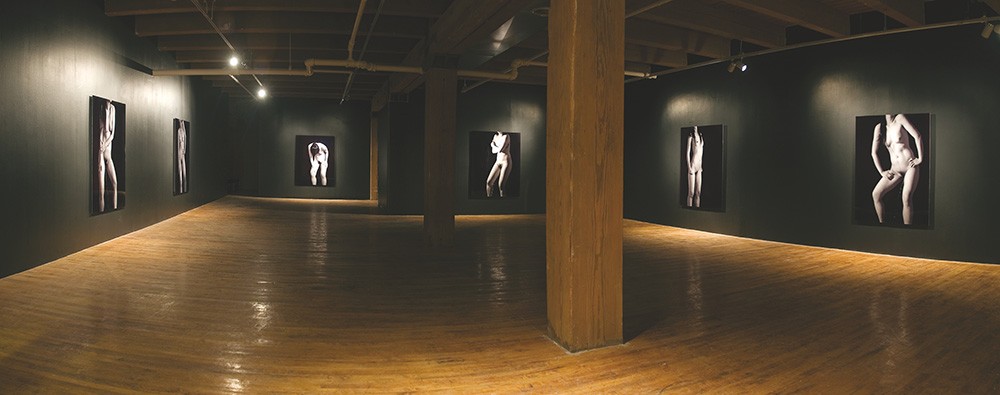
CHANG Jia_OMERTA: Commandment of Silence_Installation View in Chicago. 2008
While the video works CHANG Jia screened at Seoul Art Cinema took as their materials the viscous fluids that flow from the body’s ‘orifices’ - tears shed over a broken heart, saliva exchanged during a kiss, and menstrual blood - in her 2007 solo exhibition OMERTA: Commandment of Silence at Alternative Space LOOP, she approached the nature of taboos imposed upon women through the unusual material of ‘urine.’ At this time, she also expanded her practice beyond video to encompass photography and installation.
Her Fixation Box (2007) is an installation consisting of an acrylic box containing objects commonly found in an aquarium alongside objects frequently used by women, their surfaces encrusted with crystallized salt and urine. Her Fixation Object (2007), meanwhile, is a photographic series depicting objects encrusted with urine and salt crystals. While Women Urinating Standing Up consists of black-and-white photographs of women urinating while standing in a variety of poses, Standing Up Peeing-Video is a video work documenting the actual photo shoot for Women Urinating Standing Up.
CHANG Jia’s Women Urinating Standing Up can be understood as a metaphorical way of “speaking about the discomforts of living as a woman.” More specifically, the act evokes the discomfort women experience when attempting to adapt to a world governed by predominantly male-centered rules and conventions.

CHANG Jia_P-Tree_Under the Installation. 2007
Her P-Tree is an installation in which glass spheres filled with urine hang from a tree-shaped metal structure. CHANG connected the glass spheres to one another with rubber tubes, designing the system so that the urine would be gradually purified as it flowed downward through the tree-like structure. Through the rubber tubes, the urine dripped at regular intervals onto seeds placed below, causing them to sprout. In this sense, her ‘urine-tree’ gives rise to new life through bodily waste - urine. This is precisely why CHANG transforms bodily waste into an object of aesthetic contemplation.
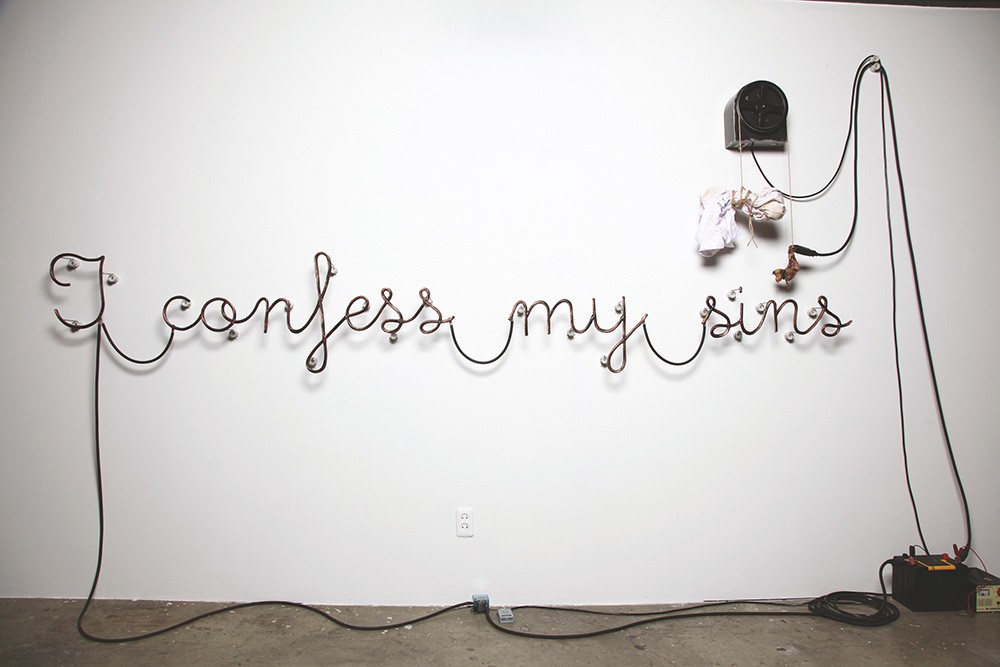
CHANG Jia_I Confess My Sins_Installation_350×40×250cm. 2011
In 2011, CHANG Jia held her fifth solo exhibition, I Confess. Her I Confess My Sins (2011) is an installation featuring the English phrase “I confess my sins,” formed from electrical wire and mounted on the gallery wall. A pulley is installed on the wall to the right of the text. Suspended from opposite ends of the pulley are the artist’s work clothes, rolled tightly into a bundle, and a chicken leg; as one descends, the other rises, alternating continuously between upward and downward movement.
Both the work clothes and the chicken leg, however, are connected to a car battery, allowing an electric current to flow through them. Beneath the pulley, the phrase “I confess my sins” is formed from exposed electrical wires with their insulation removed. As the pulley rotates and the chicken leg comes into contact with the wires, sparks fly, accompanied by the sound of flesh being scorched and the smell of burning meat.
Interestingly, the point at which both the work clothes and the chicken leg make contact is precisely the word ‘sins.’ Unlike the chicken leg, of course, the artist’s work clothes do not produce sparks when they touch the wires. Nevertheless, the work can be read metaphorically as subjecting the artist herself to electrical torture.

CHANG Jia_Sitting Young Girl_C-Print_150×170cm. 2009
CHANG Jia’s Sitting Young Girl (2009) is a photographic work depicting a naked woman seated atop a tank teeming with live eels. Eels are said to have an instinctive tendency to burrow into dark holes and crevices among rocks. The eels in the tank seem poised to raise their heads and charge toward the woman’s 凹. Yet this scene is said to refer to a form of torture used by a queen during China’s Qin dynasty against a concubine who had monopolized the king’s affection.
CHANG Jia’s Boy Lying in a Bamboo Forest (2010) is a photographic work depicting a handsome young man in a beautiful bamboo grove, his naked body covered only at the 凸 with a piece of white cloth. With his lips slightly parted, he gazes toward the viewer. Yet the photograph is, we are told, a staged scene of torture. In other words, if a naked body were bound and left lying in a bamboo grove, bamboo shoots emerging from the ground would eventually begin to inflict torture upon it. CHANG has transformed an atrocious method of torture into an erotically staged scene. If so, is her torture not playing somewhere between pain and pleasure?

CHANG Jia_To Survive the Death_Cowhide_200×200cm. 2013
From 2012 to 2017, CHANG Jia created a body of drawings by burning images into cowhide with a heated iron. These works include Burned Landscape (2012), Self-Portrait (2013), Pasta (2013), Burning Time (2013), To Survive the Death (2013), The Power of the Weak (2014), Switch (2014), He, Not She (2014), Ghost Gui (鬼) (2014), Burning Time (2014), and The Ovum-The Scent of Orchids and the Scent of Musk (2017).
Burned Landscape and To Survive the Death are monumental works made from the entire hide of a single cow. Burned Landscape resembles a traditional landscape painting. Burned into the cowhide with a heated iron, the landscape features mountains and houses, men and women riding horses toward some unknown destination, and a boatman rowing a small boat. Looking at the landscape, one can almost hear the sizzling sound of the hot iron searing the cowhide and smell the hide as it burns. Yet out of the pain inflicted upon the cowhide, a landscape of pleasure is born.
CHANG Jia’s To Survive the Death resembles a medieval parchment manuscript inscribed with text and illuminated with miniature images. At the center of the cowhide, she burns the words “To Survive the Death” into the surface with a heated iron. Above the text, a strange black form catches my eye: it looks at once like a vertical black ribbon and a black blindfold. To the left of this black form, a man and a woman are depicted with a heated iron, seemingly embracing each other. To the right, within an oval shape resembling a mirror, is a face with two fingers held to its lips.
If you take one step further into these images, you may begin to discern a certain connection between them. In the first image, for instance, the man and woman do not appear simply to be embracing; rather, the woman seems to be whispering something secret into the man’s ear. In the second image, the figure appears to emphasize silence by placing two fingers against the lips. What on earth could the woman have whispered to the man? Whatever he has heard from her, the expression on his face is serious.
To the right of the words “To Survive the Death,” a musical score appears. Needless to say, the score, which gives visual form to rhythm, has been burned into the cowhide with a heated iron. It is the score of Ludwig van Beethoven’s Moonlight Sonata. Between the lines of Beethoven’s Moonlight Sonata, CHANG Jia introduces naked female figures, likewise burned into the surface with a heated iron. As the women progress upward from the bottom, they gradually remove their tops. Alongside these topless women, wearing only their underwear, various other images appear: a person wearing a fox mask; an image that seems to show a Venus standing on a pedestal resembling marble, having removed her top and placed it in a bucket; and a naked woman crouching in a flower garden, her body tightly entwined with rose vines.
Beneath the musical score are people strolling between two skulls: a person carrying an umbrella, people walking with a companion or a dog, and someone walking alone. Their paths are none other than the tongues of the skulls. Thus, they are not walking from life toward death; rather, they are strolling between death and death. Below the words “To Survive the Death” appear human figures rendered in simple lines. They are linked together, each seemingly pointing clockwise toward the next. At the very end, a long-necked giraffe appears.
As I traced the enigmatic imagery of CHANG Jia’s To Survive the Death, I suddenly found myself thinking of One Thousand and One Nights (千一夜話) - the tales told over one thousand and one nights by the maiden Scheherazade to King Shahryar in order to survive, when she faced death after spending a single night with the king.

CHANG Jia_Beautiful Instruments I_2009-2011_Installation View
For Gallery R’s special exhibition KAR, CHANG Jia presents works from her Beautiful Instruments series. Her Beautiful Instruments I (2009-2011) is an installation displayed in glass showcases, consisting of high heels made by the artist herself, painted and carved wooden rods, and objects incorporating women’s accessories. Yet if we examine these objects closely, we begin to realize that these ‘beautiful instruments’ are, in fact, ‘instruments of torture.’
On the wooden rods, CHANG has reproduced engravings depicting representative forms of torture from the Middle Ages, a period often associated with the development of elaborate instruments and methods of torture. On the reverse sides, she has carved German decorative motifs that were fashionable in the sixteenth century.

CHANG Jia_Beautiful Instruments II_Mixed Media_110×70×105cm. 2012
CHANG Jia’s Beautiful Instruments II (2012) is an installation in which a glass display case is placed at the center of the exhibition space, containing an array of tools in various forms. These are meticulously crafted implements of unusual shapes. If you take one step further into these objects and examine them closely, the traces of age they bear might lead you to assume that they were actually used long ago.
While Beautiful Instruments I consists of objects made by the artist herself, Beautiful Instruments II is composed of a kind of “found object.” In 2011, CHANG visited Yunnan, China, as part of the 2011 Nomadic Residency Program organized by the ARKO Art Center. She reportedly purchased these implements at a traditional market in Yunnan. According to CHANG, their original function was as surgical instruments used in China in the late nineteenth century.
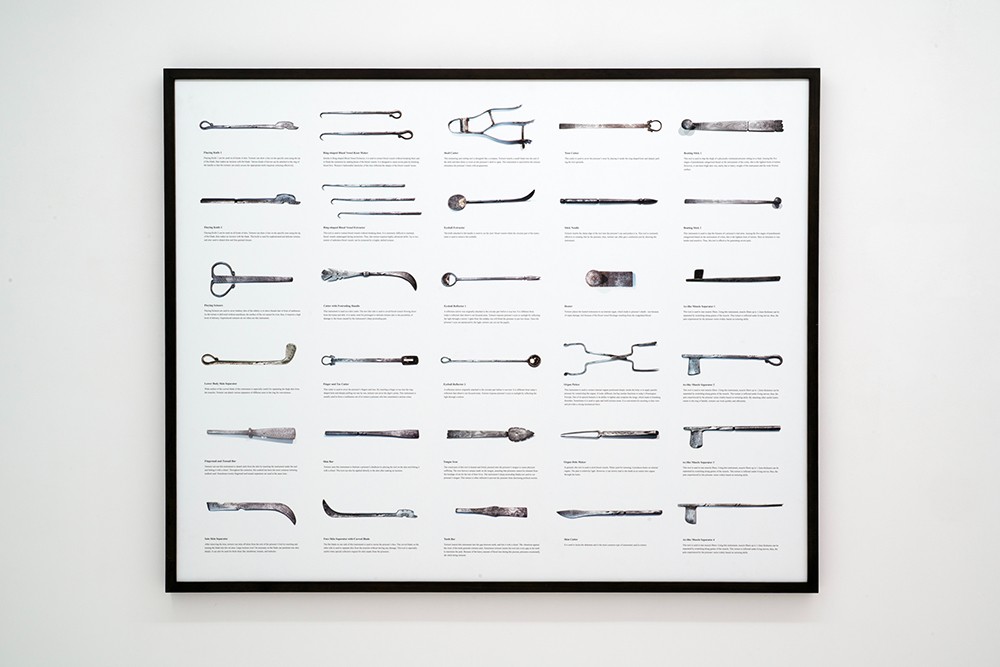
CHANG Jia_Beautiful Instruments II-Two-Dimensional Work_C-Print_120×150cm. 2012
Helpfully, CHANG Jia also exhibited Beautiful Instruments II-Two-Dimensional Work, for which she photographed the various implements, printed the images, and even provided a kind of “instruction manual” for them on the gallery wall. The implements are identified as follows: skinning knife, skinning scissors, shin elevator, dental elevator, organ forceps, skin incision tool, sole skin separator, loop-type blood vessel ligator, lower-body skin separator, axe-shaped muscle separator, finger and toe cutter, tongue cautery iron, nose cutter, eyeball extractor, skull-opening instrument...
Does this mean, then, that these implements were not ‘surgical instruments’ but ‘instruments of torture’? As a specific example, let us look at the “finger and toe cutter.” It consists of a long metal bar with two rectangular openings, one large and one small, and a circular ring at its left end. CHANG provides the following instructions for the “finger and toe cutter”:
“This cutting device was used by inserting the fingers or toes into the ring-shaped opening and severing them one by one with a sudden, forceful pull. Depending on the stage of bodily dismemberment, it was used to sever the fingers and toes joint by joint. It was primarily employed to extract confessions or, in cases involving particularly serious offenses, when prolonged torture was deemed necessary.”
If you focus solely on the form of the “finger and toe cutter,” it may indeed appear to be an instrument of torture of the kind described in the accompanying instruction manual. But if you take one step further into the “finger and toe cutter,” you will realize that it could not actually function effectively as a device for severing fingers and toes. This is because the inner edges of the openings are not sharp enough to sever a finger or toe, even if one were inserted into the device and pulled with sudden force. It follows, then, that this was not in fact an instrument of torture used to cut off fingers and toes.
CHANG Jia’s Beautiful Instruments II can therefore be understood as a work that transforms surgical “instruments of healing” into visual “instruments of torture.” In other words, she takes surgical instruments used in late nineteenth-century China to save the lives of the sick and imaginatively transforms them into instruments of torture designed to inflict pain on otherwise healthy bodies. By overturning the conventional instruction manual for these instruments, CHANG awakens the viewer’s imagination. If so, might any instrument be transformed into an instrument of healing or an instrument of killing, depending on how its user chooses to employ it?
KAR English-Language Catalogue: “A User’s Manual
for the Artworks”
Publisher: KAR Publishing
Publication Date: September 11, 2026
Pages: 1,512
Price: KRW 1,000,000
I began preparing for Gallery R’s special exhibition KAR five years ago. With the wholehearted support of HWANG Youngbae, CEO of KAR Co., Ltd., I was able to organize exhibitions consistently at Gallery R over the course of those five years and to publish an “e-catalogue” for each exhibition. Through KAR Publishing, I have published some fifty e-catalogues over the past five years. And now, at last, this work has culminated in the publication of an English-language catalogue of more than 1,500 pages.
I wanted, as far as possible, to include both the artists’ works - their images - and their own “voices,” in the form of artists’ notes, in this English-language catalogue. If you open KAR, you will be able to encounter works spanning the careers of all eight artists. You will also be able to read their artists’ notes. And you will find my own humble writings there as well. I decided to set aside my ambitions as a writer and instead become the author of a “user’s manual for the artworks” - someone whose task is to help readers understand how to approach and engage with the artists’ works.
KAR Publishing’s English-language catalogue KAR has been published to introduce the artistic practices of HONG Myungseop, KIM Eull, HA Bongho, KIM Haemin, PARK Kiwon, KIM Taeheon, AHN Sihyeong, and CHANG Jia to readers both in Korea and abroad. These eight artists represent only some of the artists whose work has drawn my attention during my thirty years of organizing exhibitions and writing art criticism as an independent curator and art critic. I therefore plan to produce a second volume of KAR, featuring another group of artists.


COPYRIGHT BY GNGLOBAL. ALL RIGHTS RESERVED.